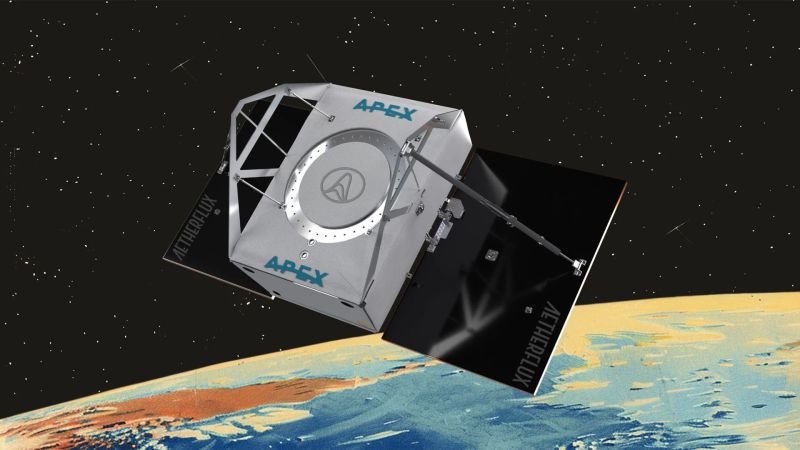
Aetherflux, a Silicon Valley startup aiming to revolutionize renewable energy distribution through Space-Based Solar Power (SBSP). As an alternative to traditional designs that rely on microwave transmission (https://lnkd.in/d_JymZr4), Aetherflux’s innovative approach utilizes infrared laser technology to beam power from Low-Earth Orbit (LEO) to many small ground receivers.
The company’s first crucial step will be launching a demonstration satellite approximately 500km (342 miles) above Earth within the next 12-15 months. This prototype mission, backed by roughly $10 million of founder Baiju B.’s personal investment, will test the transmission of an average of 1 kilowatt with a peak power of 4 kilowatt to a 10m ground receiver.
With a single satellite in LEO, power beaming will only be available for a few minutes for any location on Earth as the spacecraft passes from horizon to horizon. Aetherflux has a vision for a constellation of smaller satellites in LEO, rather than massive installations in geostationary orbit. This approach could potentially make the technology more accessible and commercially viable. The initial focus will be on providing power to remote locations, including military operations, disaster relief areas, and off-grid mining operations.
With employees drawn from companies like SpaceX and Luminar, and using a satellite bus from Apex, Aetherflux is taking a methodical approach to what Bhatt acknowledges is an extremely challenging endeavor. The upcoming demonstration mission will be crucial in proving the viability of laser-based power transmission through the atmosphere and establishing the foundation for a potential new era in renewable energy distribution.
If successful, Aetherflux envisions expanding its services to support renewable energy needs in commercial shipping and eventually supplement terrestrial power generation. With space-based solar power’s ability to provide constant energy unaffected by weather or daylight cycles, this technology could play a crucial role in helping industries meet ambitious NetZero targets while addressing the intermittency challenges faced by traditional renewable energy sources.
Aetherflux: Pioneering Space-Based Solar Power with Laser Technology