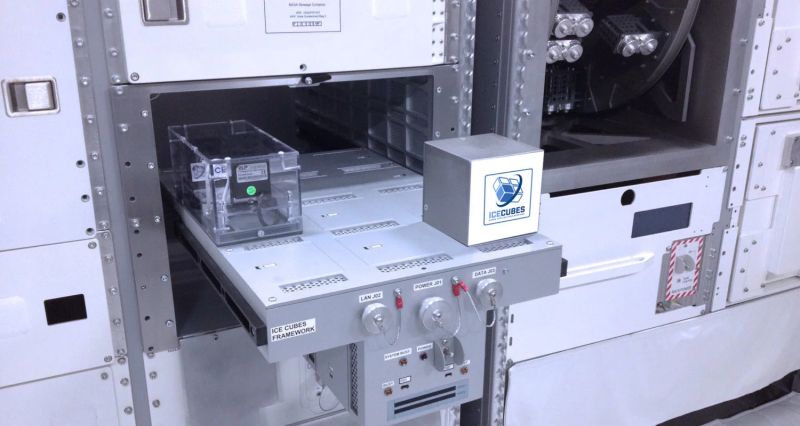
University of Oxford, NDORMS Space Innovations Lab (SIL) has achieved a significant milestone by sending its first human tissue samples to the International Space Station (ISS) to study the effects of microgravity on human aging. The samples, contained within a Science Cube, will be housed in the ISS’s International Commercial Experiments service (ICE Cubes), which provides power, data support, and real-time connectivity for Earth-based monitoring.
ICE Cubes offers 24-hour direct access to its experiments via a dedicated mission control centre at Space Applications Services NV/SA’ premises. Clients can connect at any time to their experiment from their own location over internet to read the data and even send commands directly.
The SIL project, led by Dr. Ghada Alsaleh, aims to leverage the unique microgravity environment of space to accelerate the study of aging processes that typically require extensive observation periods on Earth. “This is an exciting moment,” says Dr. Alsaleh, “not just because we’re embarking on a journey to space, but because we’re bringing along a ground-breaking project that could help people live healthier lives, both on Earth and in Space.”
The research holds particular significance as global populations continue to age, presenting increasing healthcare challenges. Aging, characterized by progressive cellular function loss, is linked to various conditions including neurodegeneration, cancer, and cardiovascular disorders. The space-based research could potentially fast-track the understanding of these processes, as microgravity is known to accelerate aging effects.
SIL, which opened in July 2023 as the UK’s first laboratory dedicated to space-focused aging research, employs cutting-edge techniques including organoids, 3D printing, and mechanical stress testing. The lab’s direct operational connection to the ISS allows researchers to closely monitor their experiments in real-time.
As we push the boundaries of space exploration, we’re simultaneously pushing the frontiers of medical science. By understanding how aging progresses under microgravity conditions, researchers hope to develop new treatments for age-related diseases, potentially improving quality of life for both future space travelers and Earth’s aging population. The insights gained from this study in space will unlock new treatments and technologies that will benefit not just future astronauts, but all of humanity.
Sending Human Cells to the ISS to Learn about Ageing