Edinburgh-based deep-tech startup RideScan is pioneering an innovative ‘teacher brain’ approach that could revolutionize safety in autonomous space missions 🚀🤖
The start-up inspired by the PhD work of founder and CEO Shivoh Chirayil Nandakumar from The National Robotarium – the Robotics and Artificial Intelligence Research Centre at Heriot-Watt University – designed this innovative solution initially for terrestrial autonomous systems. Its implications could extend far beyond Earth’s boundaries.
RideScan’s core innovation is what they call a “teacher brain” – an external intelligent monitor that observes and evaluates autonomous systems without interfering with their proprietary technology. This approach is particularly intriguing because it mirrors human cognitive processes, especially our ability to detect anomalies in familiar patterns. This teacher brain will observe multiple “children” or autonomous robots, objectively evaluate their performance, and report any abnormal behaviors including risk scores to relevant stakeholders.
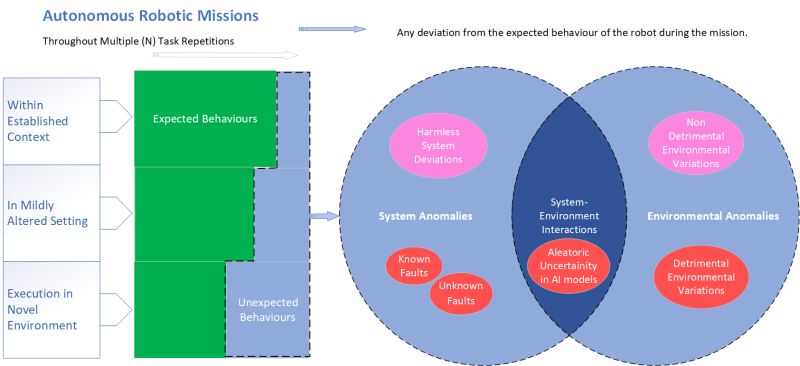
Aleatoric uncertainty is a type of uncertainty that describes outcomes that are random and cannot be predicted. The RideScan CaaS (Cognition as a Service) model detects aleatoric uncertainties and anomalies, enabling proactive risk mitigation and preventing catastrophic failures.
The space sector presents unique challenges where this technology could prove transformative. Consider autonomous spacecraft operations or future Mars rovers. These systems must operate in extreme conditions, far away from Earth, where traditional human real-time control is unfeasible due to the long communication delay.
RideScan’s technology could be adapted to create an additional layer of safety for space operations by:
1. Monitoring autonomous space systems for behavioral anomalies without requiring access to their core programming
2. Providing real-time risk assessment for critical operations
3. Detecting potential malfunctions before they become catastrophic
4. Offering valuable feedback for improving autonomous space systems’ reliability
As we rely more heavily on autonomous systems, technologies like RideScan’s could become crucial in ensuring mission success and safety. The company’s work at the National Robotarium, testing their system across various platforms from quadruped robots to robotic arms demonstrates the versatility that could make it ideal for space applications. The future of space exploration will depend not just on our ability to build autonomous systems, but on our capability to make them consistently reliable and safe.
Image Credit: RideScan – The relationship of anomalies and faults in the context of autonomous robotic missions.
AI Safety Beyond Earth: How RideScan’s ‘Teacher Brain’ Could Safeguard Space Missions