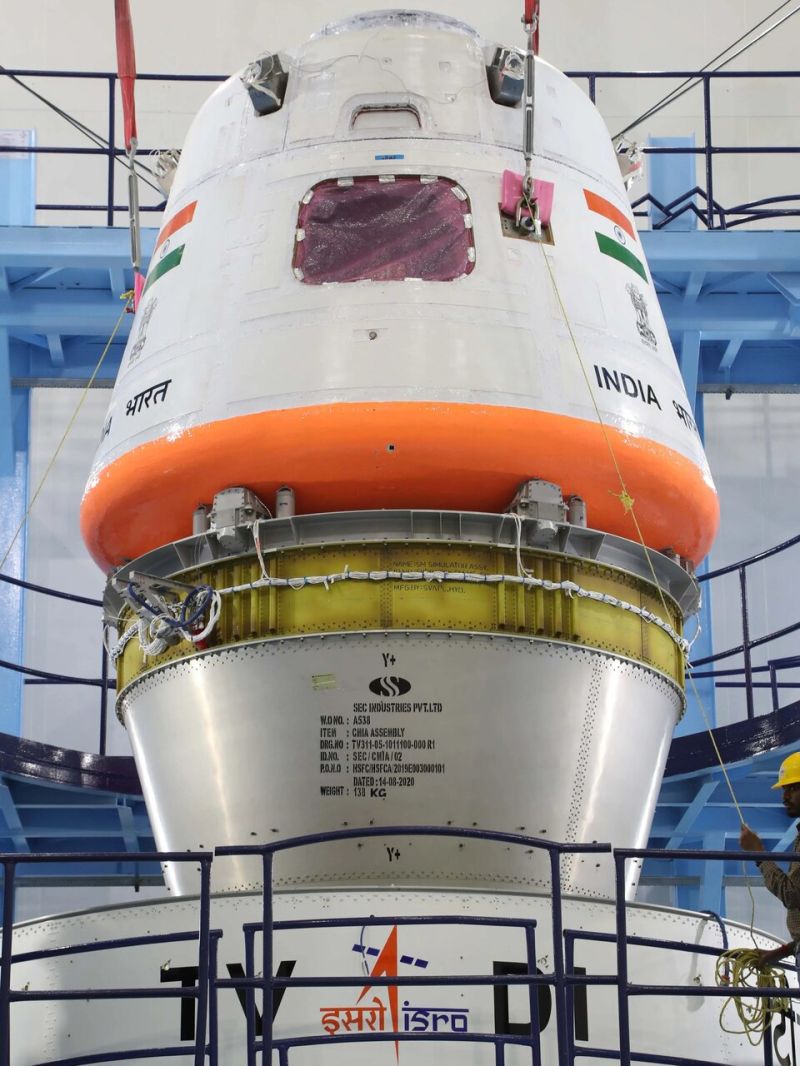
The collaboration between the Indian Space Research Organisation (ISRO) and the European Space Agency – ESA marked a milestone on December 4, 2024, with the signing of a ground station support agreement for India’s Gaganyaan human spaceflight program. This partnership builds upon a foundation of successful space cooperation, exemplified by the recent launch of ESA’s Proba-3 mission from Indian soil using an ISRO Polar Satellite Launch Vehicle-XL (PSLV-XL).
The Gaganyaan program, scheduled for its first uncrewed test mission this year in 2025, aims to demonstrate India’s human spaceflight capabilities by sending three astronauts to a 400-kilometer orbit for a three-day mission. ESA’s support infrastructure plays a crucial role, with its 15-meter antenna in Kourou, French Guiana, providing vital communication support for the initial mission. Subsequent missions will benefit from an expanded network including facilities operated by the German Aerospace Center (DLR) and the Spanish National Institute for Aerospace Technology (INTA), all coordinated through ESA’s Operations Centre (ESOC) in Germany.
The Human Space Flight Centre (HSFC) leads ISRO’s efforts in developing critical technologies including human-rated launch vehicles, life support systems, and crew emergency escape mechanisms. The LVM3 rocket – ISRO’s well proven and reliable heavy lift launcher, has been identified as the launch vehicle for the Gaganyaan mission. It consists of solid stage, liquid stage and cryogenic stage. All systems in LVM3 launch vehicle are re-configured to meet human rating requirements and the modified launcher called Human Rated LVM3 (HLVM3).
HLVM3 will be capable of launching the Orbital Module to an intended Low Earth Orbit of 400 km. Human safety stands as the paramount priority in the Gaganyaan mission, driving the development and realization of advanced engineering and human-centric systems incorporating various new technologies.
The ISRO-ESA collaboration represents a model of international cooperation in space exploration, combining European expertise in ground operations with India’s growing capabilities in human spaceflight. As ISRO progresses through its planned sequence of two uncrewed test flights toward the crewed mission, this partnership strengthens both agencies’ positions in the global space community while advancing technologies for sustainable human presence in space.
As we venture into 2025, I invite my network to join forces in advancing technological innovations and scientific discoveries that enhance life on Earth, knowing that when organizations and disciplines work together, we create opportunities that benefit us all.
ISRO and ESA: A Strategic Partnership Advances India’s Human Spaceflight Program