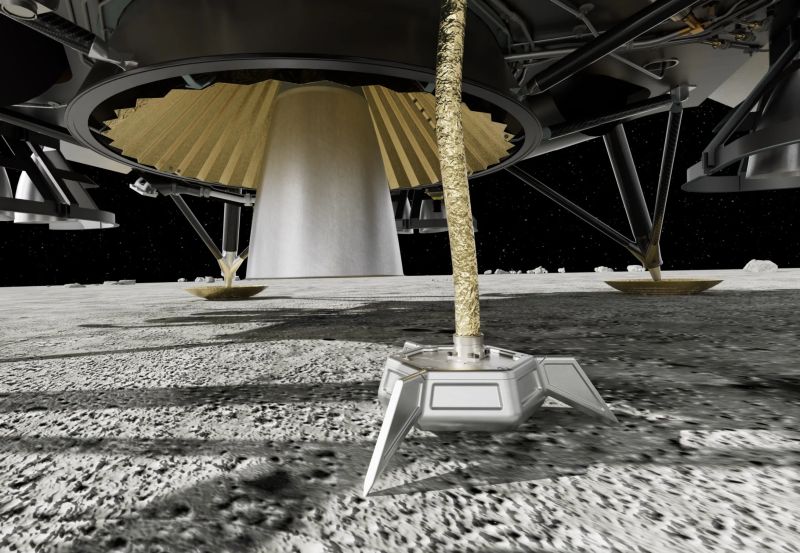
Fleet Space Technologies is preparing to deploy its SPIDER (Seismic Payload for Interplanetary Discovery, Exploration and Research) technology on the Moon’s far side in 2026. As part of Australia’s Moon to Mars initiative, the Australian Space Agency awarded Fleet a grant worth 4 million Australian dollars ($2.6 million) to support development of this geophysical device that will deliver insights about the subsurface of the lunar South Pole and search for water ice deposits. The deployment of SPIDER aboard Firefly Aerospace‘s Blue Ghost lunar mission represents the first Australian seismic technology to venture beyond Earth’s boundaries.
SPIDER builds upon Fleet’s successful ExoSphere technology, which has contributed to geological surveying on Earth. The system creates detailed subsurface maps using Ambient Noise Tomography (ANT), recording natural seismic waves to map 3D subsurface models in days compared to months with conventional techniques. This innovative approach has already served over 50 exploration companies across five continents on Earth.
The technology’s adaptation with a planned weight reduction from 9kg to 600g for space exploration demonstrates Fleet’s commitment to advancing planetary science. While initial deployment targets lunar subsurface mapping and water ice detection, the system’s capabilities extend to future Mars exploration. Understanding the subsurface environment of other worlds will prove crucial for identifying resources and selecting sites for future human exploration and settlements.
The number of mining customers using this technology on Earth has attracted substantial financial support, with Fleet recently securing $100 million in Series D funding, bringing total venture funding to over $165 million and company value to $525 million. The investment reflects growing recognition of seismic mapping’s role in planetary resource exploration.
As humanity extends its reach across the solar system, technologies like SPIDER provide essential insights for discovering planetary resources as well as possible habitable caves. Fleet’s journey from Earth-based mineral exploration to planetary exploration exemplifies how spin-in from terrestrial technology can advance our understanding of worlds beyond our own.
Mapping New Worlds: Fleet Space’s Journey from Earth to Planetary Exploration