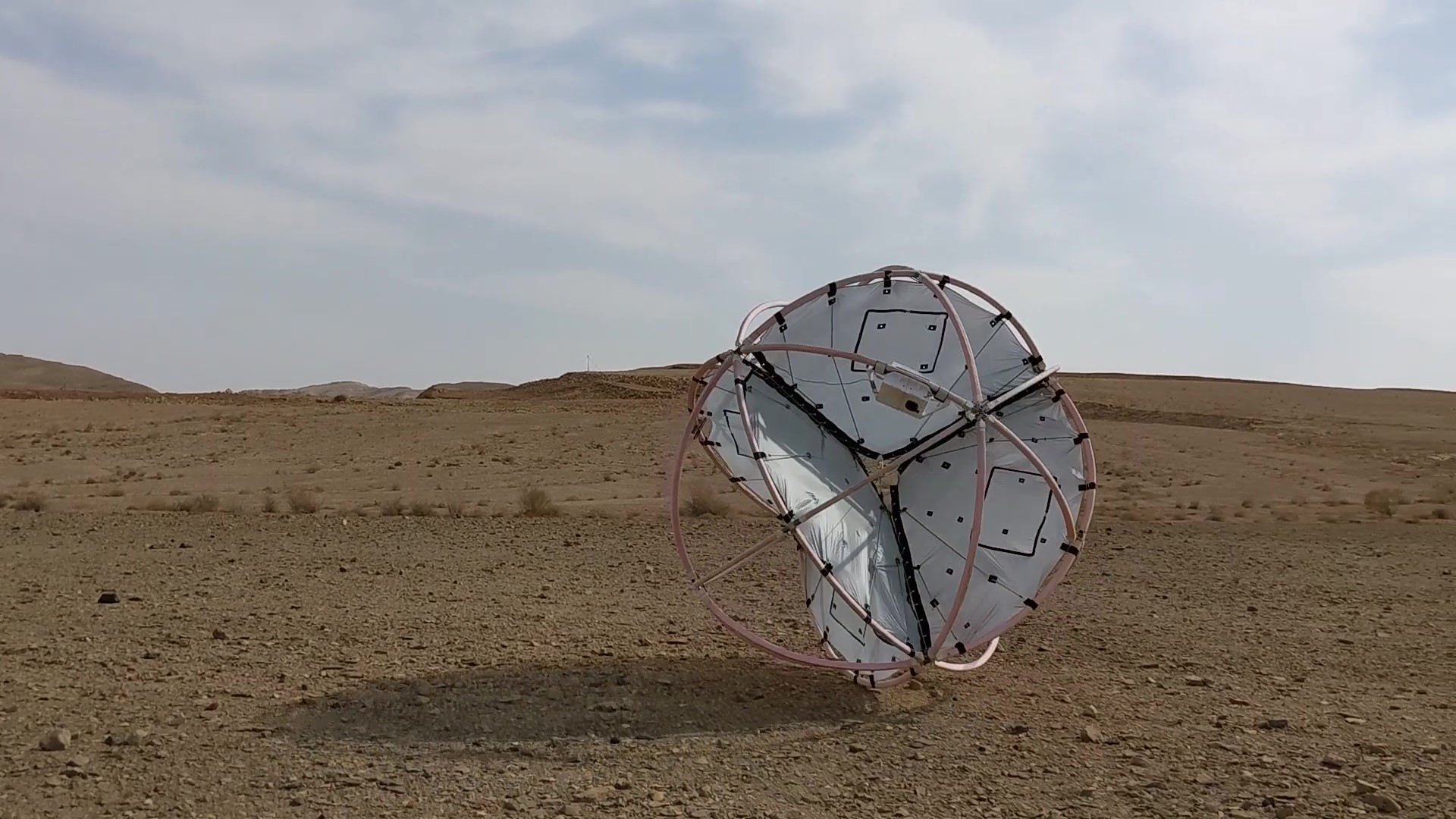
Team Tumbleweed has developed an innovative approach to Mars exploration that could revolutionize how we gather data on the Red Planet. Our work, recently accepted for presentation at the 2025 Global Space Exploration Conference (GLEX25) in New Delhi, India introduces a novel Location and Attitude Determination (LAD) system designed for high-speed Martian Tumbleweed rovers.
Traditional Mars rovers, with remarkable achievements, move at cautious speeds that limit their exploration range. Our Tumbleweed rover swarm takes a different approach, achieving speeds of 5 m/s through a wind-driven, rotating design. This represents a significant advancement compared to ESA’s next-generation lunar rovers targeting 1 m/s. The implications are substantial: our swarm configuration could collect much more data at just 1/100th the cost of traditional single-rover missions.
The challenge of precise positioning on Mars, where GNSS is not available, led us to develop a LAD system tailored to Tumbleweed’s unique requirements. Our solution combines Commercial Off-The-Shelf (COTS) sensors in a lightweight, power-efficient package. The system intelligently switches between different positioning methods: IMUs and rotary sensors during movement, Visual Odometry and satellite navigation during strategic stops, and star sensors for nighttime operations.
We’ve created a comprehensive testing environment using Unity’s real-time development platform. By incorporating high-resolution Martian elevation data and wind profiles, we’ve developed a simulation that provides realistic testing conditions for our LAD system. This virtual Mars environment serves multiple purposes beyond our immediate research, offering other teams a platform for mission planning and mechanical design validation.
Our approach to sensor selection and integration demonstrates how careful engineering can overcome the constraints of mass, size, and power while maintaining accuracy. The system’s ability to automatically trigger corrective actions like stopping the rover when errors exceed defined thresholds ensures reliable data collection during high-speed operations.
Team Tumbleweeds innovative ideas open new possibilities for Mars exploration, suggesting a future where swarms of wind-powered rovers could rapidly survey vast areas of the Martian surface, providing unprecedented coverage and data collection capabilities for scientific discovery and potential human settlement.
Advancing Mars Exploration: Location and Attitude Determination for Fast Wind-Driven Rovers