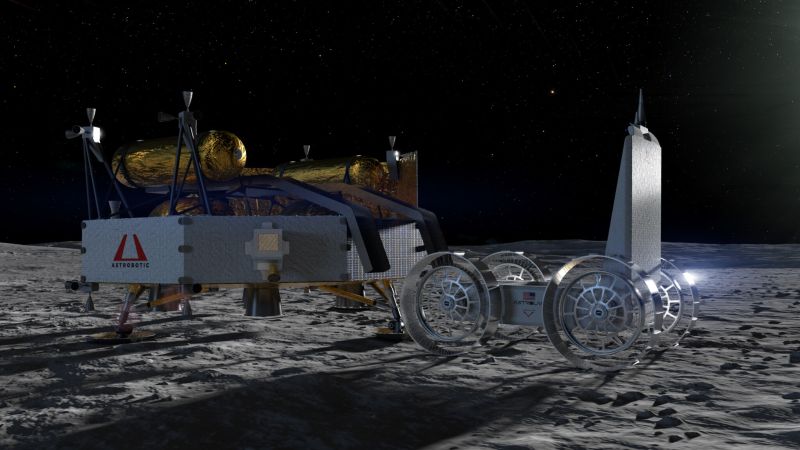
Astrolab‘s FLIP (FLEX Lunar Innovation Platform) rover will serve as the primary payload on Astrobotic‘s Griffin-1 lunar landing mission, following NASA’s July 2023 decision to discontinue the VIPER (Volatiles Investigating Polar Exploration Rover) project due to funding constraints. While NASA maintains its Commercial Lunar Payload Services (CLPS) task order with Astrobotic, the mission has transformed from a VIPER delivery into a lander demonstration flight, opening opportunities for commercial payloads to be delivered to the Moon.
The mission, scheduled for late 2025, will target the Nobile Region near the Moon’s south pole. FLIP represents a scaled-down version of Astrolab’s larger FLEX rover, carrying forward many of its innovative features to mature those technologies, while maintaining compatibility with medium-class lunar landers.
The Griffin-1 mission carries a diverse payload manifest (links to all payloads in Comments):
– FLIP rover from Astrolab, designed for technology demonstration and scientific research.
– CubeRover, a small rover developed by Astrobotic that can carry commercial payloads for lunar experiments.
– LandCam-X from European Space Agency – ESA, developed by Belgian company OIP N.V. Sensor Systems, will capture crucial landing imagery to enhance future lunar descent algorithms.
– Laser Retroreflector Array contributed by NASA – National Aeronautics and Space Administration. A token payload kept after removing VIPER.
This mission builds on valuable insights gained from Astrobotic’s first lunar attempt with Peregrine. While that mission failed due to a faulty valve, the engineering lessons learned have been integrated into Griffin-1’s development, demonstrating the iterative nature of space exploration.
FLIP itself brings substantial capabilities, with a mass of nearly half a metric ton and a payload capacity of 30 kg. The rover will conduct crucial experiments on lunar dust mitigation, testing protective coatings for solar arrays and radiators while measuring dust accumulation rates. It will also evaluate technologies like hyper-deformable tires and specialized batteries developed in partnership with VENTURI Space.
As a collaboration between commercial innovation and international space agencies, the Griffin-1 mission marks a significant step in lunar exploration technology development. By combining Astrobotic’s lander expertise with Astrolab’s rover capabilities, this mission aims to validate crucial technologies for sustainable lunar operations. Beyond its immediate scientific and technical objectives, this mission demonstrates how setbacks in space exploration can lead to new opportunities, fostering a robust commercial ecosystem that will be essential for humanity’s sustained return to the Moon.
From VIPER to FLIP: Commercial Innovation Shapes Griffin-1 Lunar Mission