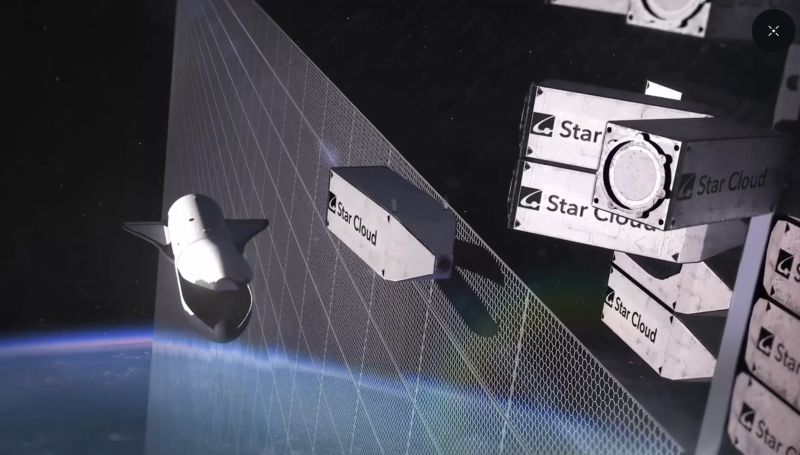
The concept of orbital data centers continues to captivate investors, with Star Cloud (formerly Lumen Orbit (YC S24)) emerging as the first company to raise funding in this field. Their architecture envisions multi-gigawatt compute clusters in space, powered by solar arrays and connected to Earth through high-bandwidth optical lasers – a direct response to the computational demands of the current AI solutions. In Europe Thales Alenia Space and Leonardo Space coordinated the ASCEND (Advanced Space Cloud for European Net zero Emission and Data sovereignty) feasibility study about data centers in space, which was co-funded by the EU.
Star Cloud has gained substantial investor attention, securing an $11 million seed round at a $40 million valuation. Their participation in Y Combinator‘s Summer 2024 batch generated interest from over 200 VCs, leading to an additional SAFE (Simple Agreements for Future Equity) round at an increased valuation. Star Cloud’s roadmap begins with a demonstration satellite carrying Nvidia GPUs scheduled for June 2025 (with Astro Digital), which will have 100x more powerful GPUs than have ever been operated in space.
While space offers inherent advantages with continuous solar power availability and natural cooling in the vacuum environment, practical challenges persist.
The most important challenge lies in the timing of technological progress. As current AI systems depend on power- and compute- intensive GPU clusters, with billions invested in generative AI companies, the field stands at a turning point.
Meta’s chief AI scientist, Yann LeCun, anticipates new AI architectures emerging within three to five years, will be much more efficient and capable than today’s big-data generative AI paradigm. “I think the shelf life of the current [AI] paradigm is fairly short, probably three to five years,” LeCun said. “I think within five years, nobody in their right mind would use them anymore.”
This likely evolution in AI prompts questions about the long-term viability of space-based GPU farms. The timeline for reduced launch costs to enable large-scale orbital data centers may extend beyond the relevance of the current GPU-centric computing approach.
Yet Star Cloud’s work retains significance beyond its initial scope. Their experiments with powerful GPUs in the space environment contribute valuable data for future space exploration and computing applications, advancing our understanding of cutting-edge hardware performance in orbital conditions.
Star Cloud’s journey reflects the complex interplay between space technology innovation and market timing. While their immediate objectives may require adaptation to evolving AI landscapes, their pioneering work in space-based computing infrastructure establishes important foundations for future space operations.
Data Centers in Space: Racing with AI Progress and Launch Economics