In the vast expanse of deep space and on distant planetary surfaces, human made navigation systems do not exist. However, the universe itself provides remarkable natural beacons that can guide our exploration efforts, offering opportunities for autonomous navigation when properly utilized.
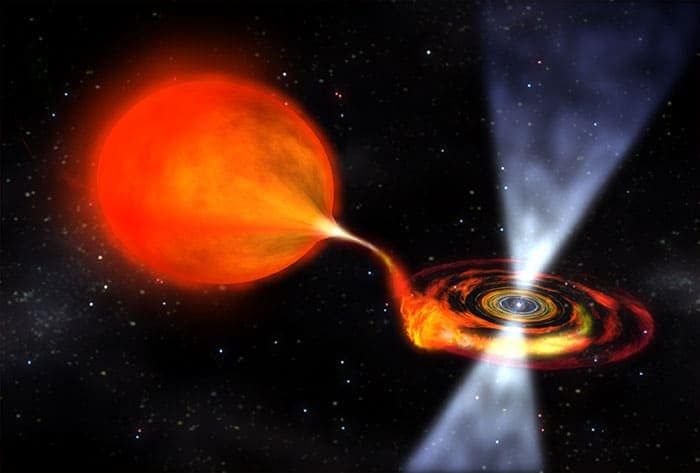
Among the various natural cosmic phenomena that scientists have explored for navigation purposes, pulsars stand out as particularly promising celestial beacons with remarkable timing precision. A pulsar, emits periodic—or repeating—bursts of radio waves, X-rays and gamma rays. The first pulsar was discovered in 1967. Use of radio pulsars as navigation beacons was first considered shortly after their discovery. The idea was later extended from radio to X-ray Navigation (XNAV). One class of pulsars, MilliSecond Pulsars (MSPs), rival atomic clocks in timekeeping accuracy and stability on timescales longer than a few weeks. Pulsar navigation can be used either by itself or as an augmentation to other methods.
The 2017 Station Explorer for X-ray Timing And Navigation Technology (SEXTANT) was a NASA funded technology demonstrator on the International Space Station (ISS) which reported a 7 km accuracy (in 2 days). In order to achieve higher accuracy sensor fusion can be implemented. A recent study [1] looked at the integration of XNAV with Spectral Redshift Navigation Systems (SRNS) through augmented extended (non-linear) Kalman filters to demonstrate the potential for a robust, multi-source navigation solution.
What makes these approaches particularly compelling is their reliance on naturally occurring phenomena. This natural approach proves especially valuable when there are no human-made artificial navigation signals and where traditional star sensors face limitations, due to a constantly moving space platform.
The key challenge now lies in developing compact, efficient sensors with low Size, Weight, Power, and Cost (SWaP-C) characteristics. As we push the boundaries of space exploration, the successful integration of multiple natural navigation methods will be crucial for enabling autonomous operation of spacecraft and planetary rovers. This convergence of natural cosmic phenomena with advanced sensors opens possibilities for navigation solutions that could guide journeys across our solar system and beyond.
Navigation Beyond Artificial Systems: Harnessing the Universe’s Natural Signals