The developmental arc of New Space startups rarely follows a linear path, with each technical challenge contributing valuable data points to the collective knowledge base. AstroForge‘s Odin mission, while not achieving the planned objectives, adds important chapters to the New Space development story – where ambitious timelines meet the complex realities of spacecraft operations beyond the Moon.
AstroForge’s trajectory reflects the iterative nature inherent to space innovation. Their first mission, Brokkr-1, launched in April 2023, encountered difficulties activating their space-based refining technology demonstration. Rather than halting progress, AstroForge adapted by shifting away from third-party components, which had caused the issues, developing the 120-kg Odin spacecraft internally. This vehicle, build in 10 months, completed vibration testing in August 2024, maintaining their launch timeline – a schedule that demonstrates the fast New Space approach to development cycles.
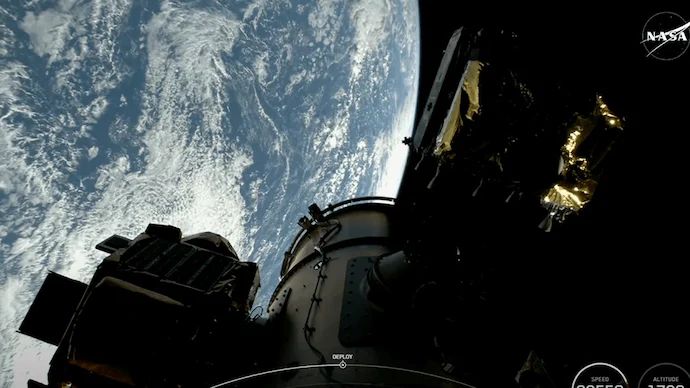
The mission began with initial success – Odin separated cleanly from the Falcon 9 launcher using exoLaunch’s separation ring. At 130 seconds post-launch, the spacecraft powered on, initiating automatic sequences for flight computers, attitude control systems, and solar panel deployment. Communication attempts subsequently revealed antenna polarization configuration issues despite pre-flight verification protocols. Ground station capabilities faced additional limitations when dishes in India detected unexpected interference from a recently installed cell tower.
At approximately 100,000 kilometers from Earth, Odin continued transmitting signals for at least 20 hours after liftoff – significantly beyond its designed 2.5-hour internal battery capacity. This means successful solar panel deployment and power generation. Odin became the first private spacecraft operating beyond the moon, albeit in an uncontrolled state
AstroForge’s transparent approach – sharing mission data with the broader space community – engaged global expertise in analyzing the signals and exploring recovery possibilities. Despite all the efforts Odin is currently a ghost-probe travelling through space, while efforts still continue to send commands to the spacecraft.
While Odin encountered technical challenges, it simultaneously contributes operational insights for future commercial space missions. As the industry builds its foundation through shared learning, this second chapter of “Don’t Give Up” demonstrates how persistence and knowledge-sharing advance the sustainable development of commercial New Space capabilities.
Don’t Give Up (Take 2): AstroForge’s Odin Mission Loss Demonstrates New Space Iterative Learning