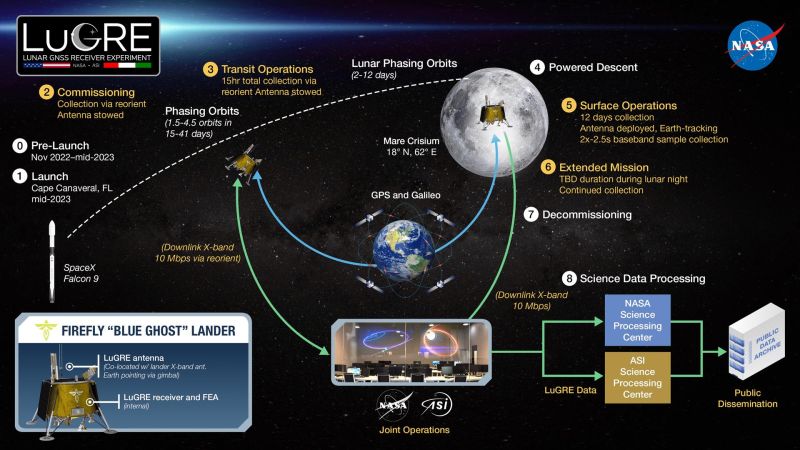
The NASA – National Aeronautics and Space Administration–Agenzia Spaziale Italiana collaboration Lunar GNSS Receiver Experiment (LuGRE), is the first Italian payload to reach the lunar surface. The use of Global Navigation Satellite Systems (GNSS), which were designed for navigation on Earth expanded significantly on March 3, 2025, when the LuGRE payload successfully acquired Galileo and GPS navigation signals on the lunar surface. This achievement, demonstrates the practical application of an existing technology in a new frontier, approximately 360,000 km from our home planet. LuGRE, was transported to the Moon aboard Firefly Aerospace‘s Blue Ghost lander under NASA’s Commercial Lunar Payload Services (CLPS) initiative with 9 other payloads.
The technical heart of LuGRE centers on a specialized GNSS receiver developed by Italian space technology company QASCOM. This system processes the attenuated signals from GPS and Galileo constellations at lunar distances.
The mission objectives are:
1- Receive GNSS signals at the Moon. Return data and characterize the lunar GNSS signal environment.
2- Demonstrate navigation and time estimation using GNSS data collected at the Moon.
3- Utilize collected data to support development of GNSS receivers specific to lunar use.
Now operating on the lunar surface, LuGRE continues data collection over a planned 14-day operational period. This sustained presence enables researchers to gather comprehensive information about signal availability, strength variations, and navigation performance.
For future Artemis missions and international lunar exploration efforts, this capability potentially reduces reliance on ground-based tracking networks while enabling more autonomous operations on and around the Moon. The technology demonstration also suggests that missions throughout cislunar space may leverage Earth-based GNSS constellations for navigation fixes.
This milestone exemplifies the power of international collaboration in advancing space exploration capabilities. As humanity establishes a sustainable presence beyond Earth, these collaborative efforts will continue to bridge technological gaps for the lunar economy. LuGRE represents not just a technical achievement, but a model for how nations and organizations can work together to solve the complex challenges of exploring and eventually inhabiting our celestial neighbour.
From Earth to the Moon: GNSS Technology’s Cislunar Reach