


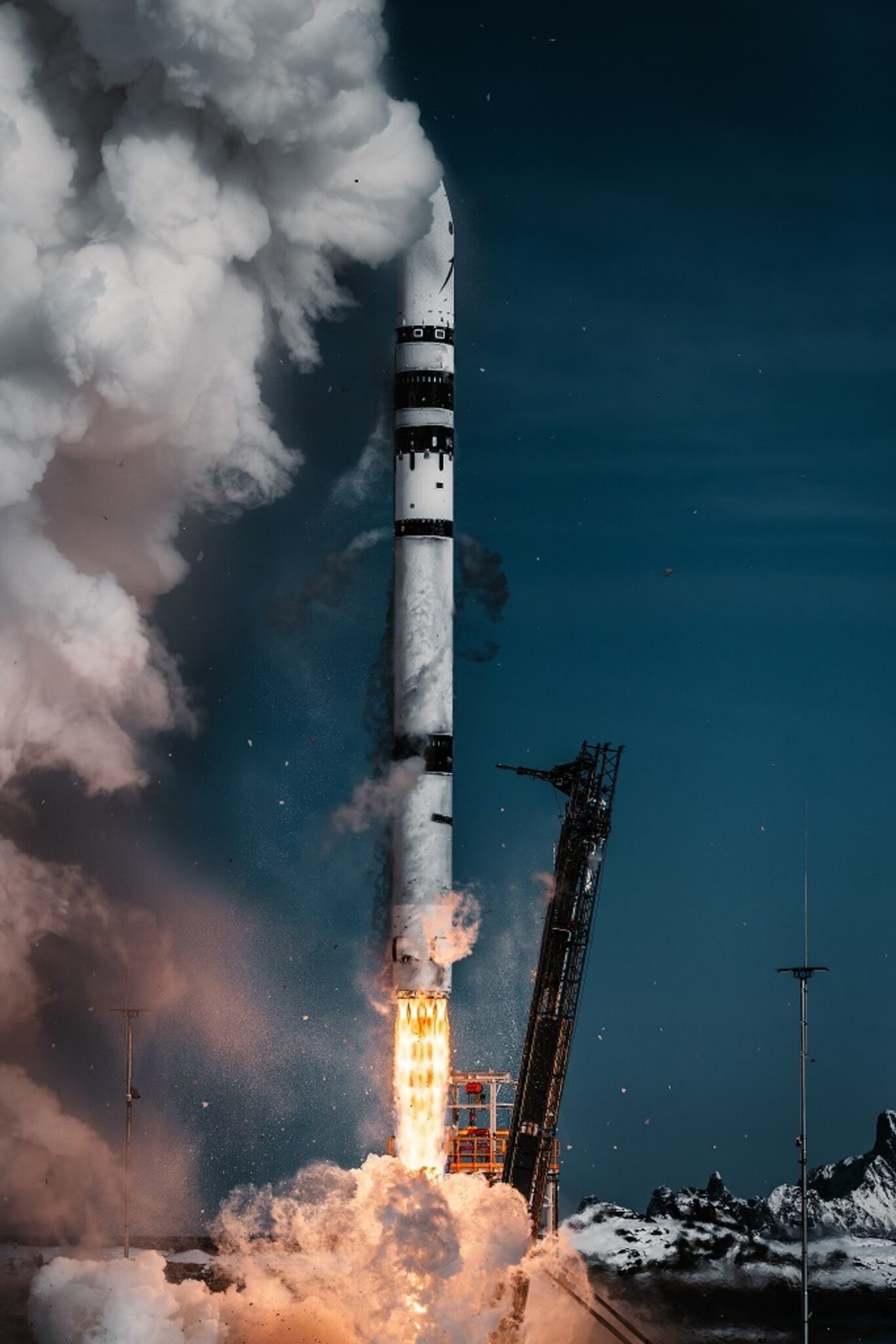
The first launch of Isar Aerospace’s Spectrum rocket provided crucial engineering insights despite ending approximately 30 seconds after liftoff on March 30, 2025. The two-stage, 28-meter tall vehicle designed to carry up to 1,000 kilograms to low Earth orbit successfully launched from Andøya Spaceport in Norway at 12:30 CET after several weather-related delays from its original March 24 launch date
The live broadcast showed successful ignition of the nine first-stage Aquila engines and a clean liftoff from the pad. However, around 18 seconds into flight, the rocket’s vector control system appeared to begin overcorrecting. The rocket’s propellant lines were successfully cut as part of safety protocols – a neutralization method common in smaller launch vehicles as it is anticipated that smaller rockets cannot cause major ground damage. This resulted in the rocket starting to fall.
The official broadcast feed cut away moments before impact and an explosion was heard, but additional footage from vol.no captured the rocket exploding near the launchpad as it fell back to Earth.
Despite the early flight termination, Isar Aerospace CEO Daniel Metzler confirmed that the launch pad remained intact. ESA Director General Josef Aschbacher offered encouragement, stating: “Success to get off the pad, and lots of data already obtained. I am sure Isar Aerospace will learn a lot. Rocket launch is hard. Never give up.”
Prior to the launch, Metzler revealed that the company is already constructing two additional Spectrum rockets and pledged to “swiftly return to the launch pad no matter the outcome of the first flight test.”
This launch represents the iterative approach characteristic of NewSpace companies, where each attempt generates valuable flight data that drives rapid design improvements. The wealth of telemetry collected during these crucial seconds will help with the updates for the next launcher pushing European spaceflight capability forward one launch at a time.
Isar Aerospace First Launch Does Not Go as Planned: Valuable Data Collected Despite Early ‘Full Spectrum’ Flight Termination
One thought on “Isar Aerospace First Launch Does Not Go as Planned: Valuable Data Collected Despite Early ‘Full Spectrum’ Flight Termination”
Comments are closed.