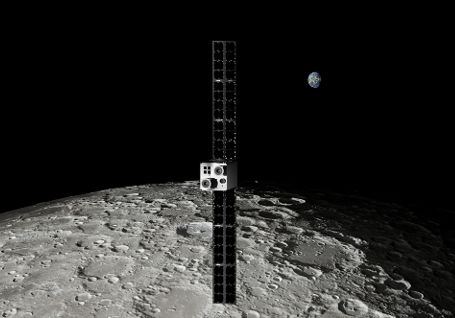
Brazil is marking a historic milestone in its space exploration journey with SelenITA, the nation’s first collaborative mission to the Moon. In June 2021 Brazil signed a cooperation agreement with NASA – National Aeronautics and Space Administration to be part of the Artemis space program, the first Latin American country to do so. The Brazilian Space Agency (AEB/MCTI) contracted Instituto Tecnológico de Aeronáutica – ITA with financial support from Finep to build a CubeSat and some of the science instruments. This international, interdisciplinary and low-cost mission represents a significant advancement in Brazilian space capabilities. Some of the science instruments will be provided by the universities of Iowa and Michigan, both in the US, in addition to NASA’s Marshall Space Flight Center (MSFC). The CubeSat is expected to be completed in 2028. The spacecraft name SelenITA was inspired by Selene, the goddess of the Moon in Greek mythology.
SelenITA distinguishes itself through its innovative dual-point measurement approach. The planned one year mission consists of a 12U CubeSat carrying a surface package designed to gather synchronized data on lunar dust, particles, and electromagnetic fields. This multi-point collection strategy offers unprecedented insights into the complex lunar environment.
The following payloads, designed to meet low Size, Weight and Power (SWaP) requirements, will be on the spacecraft:
• Ionizing Radiation Detector (IRAD)- ITA
• Charge Analyzer Responsive to Local Oscillations and Solar Winds – NASA MSFC
• Lunar Electron and Ion Analyzer (LEIA) – University of Iowa
• Magnetometer – University of Iowa
• Plasma Wave and Dust Experiment – ITA
• Spacecraft Charge Detector – University of Michigan
The science objectives are in the pdf provided in the comments. The mission demonstrates Brazil’s commitment to cost-effective, high-impact space science. By leveraging CubeSat technology, SelenITA maximizes scientific return while maintaining reasonable development costs. This approach opens pathways for emerging space nations to make meaningful contributions to lunar exploration.
The SelenITA project exemplifies effective international scientific partnerships between Brazil and U.S. institutions. This collaborative framework unites Brazilian engineering expertise in developing the CubeSat with specialized scientific instruments from both countries, creating a balanced model for space science cooperation. Through this pioneering mission, Brazil strengthens its position in the global space community while working alongside U.S. partners to advance lunar science and contribute meaningful capabilities to humanity’s return to the Moon.
SelenITA: Brazil’s Pioneering Lunar Mission Advancing Space Science