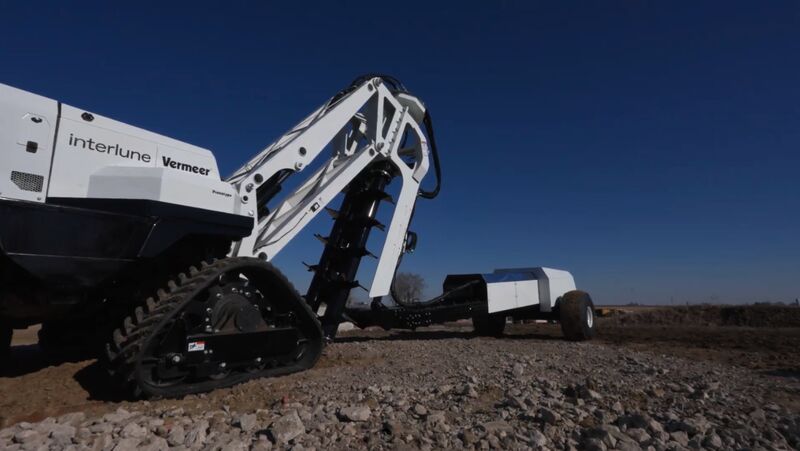
Space resources startup Interlune announced that its first customers have signed orders to buy Moon-mined Helium-3. The U.S. Department of Energy (DOE) Isotope Program agreed to purchase three liters of the lunar-extracted Helium-3 for delivery no later than 2029. Interlune also unveiled a new commercial customer: Maybell Quantum. Maybell, a quantum computing infrastructure company building ultra-cool refrigerators to keep quantum devices at near-absolute zero temperatures, agreed to purchase thousands of liters of Helium-3 for annual delivery between 2029 and 2035.
Helium-3 (He-3), a non-radioactive isotope of helium, is exceptionally scarce on Earth but relatively plentiful on the moon. Over billions of years, solar winds have bombarded the lunar surface, embedding helium-3 into the moon’s soil. It is one of the most expensive resources on the planet—selling for about $20M per kg, according to Interlune CEO Rob Meyerson.
The out-of-this-world price tag is driven by both scarce terrestrial supply and increasing demand:
• Terrestrial Helium-3 is a nuclear energy byproduct with an extremely limited global supply. In the US, it’s been rationed by the DOE IP since 2010 due to the critical shortage.
• There’s a growing need to keep quantum systems extremely cold. Helium-3 is a vital resource in quantum refrigerators.
• Helium-3 offers a pathway to clean energy with minimal radioactive waste using nuclear fusion.
Helium-3 is currently arguably one of the only resources that’s priced high enough, with sufficient customer demand, to warrant going to space and bringing it back to Earth.
Interlune has outlined a three-phase plan to harness Helium-3’s potential. The first phase, Crescent Moon, will use a hyperspectral camera to identify Helium-3-rich areas on the moon. Next, Prospect Moon will involve deploying a lander to conduct on-site measurements and test early extraction technologies. Finally, the Harvest Moon phase aims to complete the extraction process and deliver helium-3 to Earth, fulfilling contractual agreements.
The company’s business model depends on extensive supporting infrastructure developing in parallel—launchers to send Interlune technology to the Moon, landers to bring excavators down to the surface, and most importantly, return spacecraft to deliver Helium-3 to Earth.
Interlune’s orders represent more than a single company’s achievement—they signal the maturation of an entire ecosystem. From launch providers to processing equipment manufacturers, the space resources economy now has its first solid business case, creating opportunities for countless New Space start-ups to build the enabling infrastructure that makes lunar commerce viable.
Helium-3 Orders Marks Major Milestone in Space Resource Economy