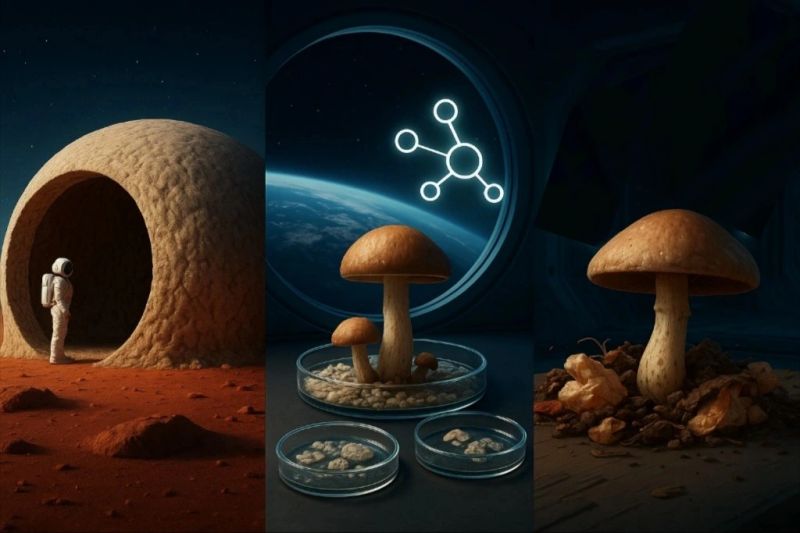
During the 1980s and 1990s, astronauts on the Russian Mir Space Station discovered that familiar Earth fungi, such as Penicillium chrysogenum and Aspergillus versicolor, were capable of thriving in space [1,2]. This served as the first proof that terrestrial fungi can adjust to the conditions of space and microgravity.
Since that discovery on the Mir Space Station, scientists have increasingly focused their research on fungi, particularly mycelia, which are the root-like structure of fungi. Researchers have identified multiple applications where mycelia could prove beneficial for space missions. Several concepts have progressed from theoretical frameworks to experimental validation, including the use of mycelia for radiation shielding.
The melanin-containing fungus Cladosporium sphaerospermum was found to grow on the International Space Station, decreasing radiation exposure by approximately 2.17% and flourishing 21% more in a space environment [3] indicating its potential use for biological radiation shielding.
A promising area of research involves developing fungi as a sustainable food source for astronauts. The MushVroom mission, led by FOODiQ Global and Dr. Flávia Fayet-Moore, successfully cultivated oyster mushrooms in space during the Fram2 mission [4]. Researchers selected these mushrooms based on their rapid growth cycles, minimal resource requirements, and high nutritional density. The project examines comparative growth patterns between space-based and terrestrial cultivation environments. Beyond addressing astronaut nutrition requirements, this research could fundamentally transform space-based food production systems and contribute to addressing terrestrial food security challenges.
For pharmaceutical development, NASA – National Aeronautics and Space Administration and University of Southern California collaborated to send the fungus Aspergillus nidulans to the ISS, investigating whether space conditions such as microgravity and radiation exposure could activate dormant genes that could produce new medicinal compounds [5]. While these genes remain inactive under terrestrial conditions, preliminary results from the space environment revealed altered fungal behaviour and the production of unique metabolites [6]. This research could help with manufacturing medicine in space and possibly lead to the discovery of new drugs that remain undiscovered under terrestrial conditions.
While the fungal growth on Mir began as an unplanned discovery, it has since evolved into important space biotechnology research. The diverse applications now under development—from self-healing habitats and radiation shielding to pharmaceutical synthesis and sustainable food production—point toward fungi serving as an important component for human planetary exploration.
From Unplanned Discovery to Important Resource: How Fungi Could Power Humanity’s Multi-Planetary Future