A recently published report by London Economics Ltd, “Size and Health of the UK Space Industry 2024,” which analyzed the 2022/23 financial year and was funded by the UK Space Agency, provides valuable insights into the space sector’s workforce composition.
𝐒𝐢𝐳𝐞
Space industry employment exhibited strong growth of 3,521 (+7%) relative to 2021/22, with an estimated 55,550 Full Time Equivalents (FTEs).
𝐍𝐚𝐭𝐢𝐨𝐧𝐚𝐥𝐢𝐭𝐲 𝐃𝐢𝐬𝐭𝐫𝐢𝐛𝐮𝐭𝐢𝐨𝐧
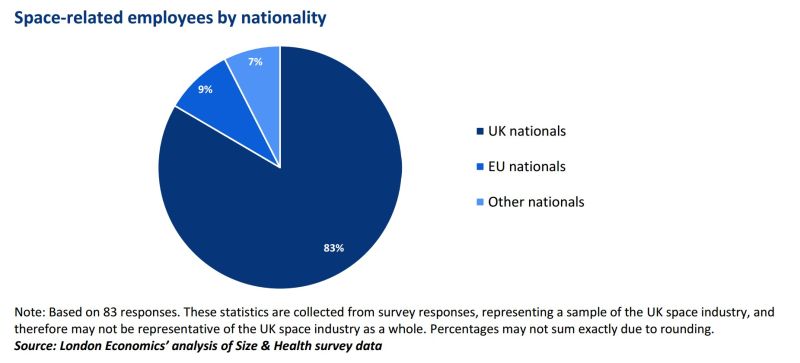
UK nationals comprise 83% of the space-related workforce among survey respondents. This concentration reflects the sector’s traditional dual-use nature and security requirements, where UK citizenship and sometimes basic security clearance are prerequisites for employment in space and defence roles. 7% amongst survey respondents were from nationalities other than the UK and EU.
𝐀𝐠𝐞 𝐃𝐞𝐦𝐨𝐠𝐫𝐚𝐩𝐡𝐢𝐜𝐬
The traditional workforce shows a mature profile, with the 50-64 age bracket representing the largest segment at 36%, followed by 35-49 (30%) and 25-34 (21%). As the New Space economy expands, I anticipate a shift toward younger demographics, with the under 25 and 25-34 brackets likely to grow while the 50-64 segment contracts.
𝐆𝐞𝐧𝐝𝐞𝐫 𝐑𝐞𝐩𝐫𝐞𝐬𝐞𝐧𝐭𝐚𝐭𝐢𝐨𝐧
Men represent 77% of the space workforce, with women comprising 23%. This contrasts sharply with the broader UK labour force, where the split is 52% men and 48% women. The survey however, doesn’t capture today’s fuller understanding of gender diversity.
I predict that the percentage of female employees will increase thanks to the growing number of female astronauts and space communicators, combined with New Space developments.
𝐄𝐭𝐡𝐧𝐢𝐜𝐢𝐭𝐲 𝐁𝐫𝐞𝐚𝐤𝐝𝐨𝐰𝐧
White ethnic groups account for 88% of space employees (compared to 82% White in the 2021 England and Wales census). Asian or Asian British representation stands at 8% (9% in the census), while Black, Black British, Caribbean, or African workers are underrepresented at 2% (4% in the census). Mixed ethnic groups also show slight underrepresentation at 2% (3% in the census).
While I remain hopeful that the New Space economy will drive improvement toward census-representative levels, my interactions with nearly one hundred New Space start-ups have unfortunately shown similar patterns, with Black representation remaining at approximately 2%.
The space industry’s workforce composition reflects both its traditional security-conscious culture and the transformative potential ahead. The New Space economy is fundamentally reshaping not only how we design and build space systems but also how we approach workforce composition. This shift opens pathways for international talent, gender equality and diversity inclusion.
UK Space Industry Workforce: Insights from the Latest 𝐒𝐢𝐳𝐞 𝐚𝐧𝐝 𝐇𝐞𝐚𝐥𝐭𝐡 𝐨𝐟 𝐭𝐡𝐞 𝐔𝐊 𝐒𝐩𝐚𝐜𝐞 𝐈𝐧𝐝𝐮𝐬𝐭𝐫𝐲 2024 𝐑𝐞𝐩𝐨𝐫𝐭