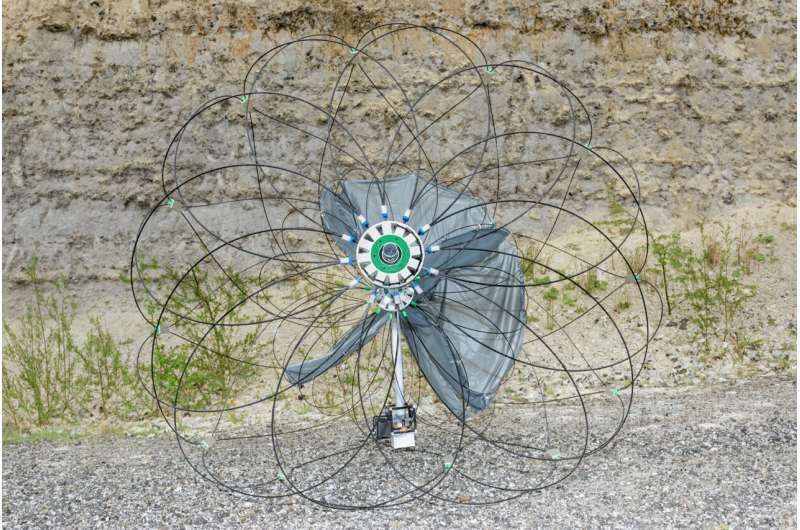
NASA’s Curiosity and Perseverance rovers have delivered groundbreaking science, but their expense makes surface exploration affordable only for space agencies. Team Tumbleweed aims to change this with a bold, approach: swarms of lightweight, low-cost, wind-driven rovers that roll across the Martian terrain like desert tumbleweeds.
The spheroidal rovers use Mars’ strong winds for mobility, eliminating the need for motors or wheels. Deployed in swarms, each carrying scientific instruments, they can survey vast regions of Mars at a fraction of the cost of conventional missions. Currently, the Tumbleweed concept is at Technology Readiness Level (TRL) 4, with prototype testing underway to validate its performance.
Recent wind-tunnel and field experiments have shown that the concept works. Prototypes ranging from 30 to 50 cm in diameter moved with winds as low as 10 m/s inside the Planetary Environment Facility at Aarhus University funded by the Europlanet Transnational Access Program. This is also going to be further reduced to movement with 5 m/s winds with optimising sail design and a lighter rover. Tests showed that rovers could climb slopes of up to 30° under Martian gravity at 18 m/s winds. Curiosity and Perseverance rovers travelled less than 50 km each over years. Over 100 sols, a single Tumbleweed rover could potentially travel approximately 400 km, and under favorable winds, distances of more than 2,800 km are possible.
The real strength of the Tumbleweed approach lies in numbers. A swarm of 90 rovers could cover a large area of Mars’ surface while adhering to planetary protection protocols. Planned payload upgrades — including radiation sensors, dust monitors, and soil probes — would extend the scientific value of each unit.
Team Tumbleweed’s next challenge is a field campaign in Chile’s Atacama Desert, one of Earth’s closest Martian analogs. The plan is to assess the mobility, stability and survivability of the Tumbleweed rovers in Martian analogous terrain. Another objective is to verify proposed science cases with corresponding instrumentation and to test the accuracy of the Location and Attitude Determination algorithm.
Although Mars remains the primary target, the technology has wider applications. From probing the atmospheres of other planets with winds or currents to collecting data on Earth in deserts or even oceans, the Tumbleweed rover design could redefine how humanity explores extreme environments.
By combining low-cost design, swarm resilience, and demonstrated test results, Tumbleweed rovers are proving that planetary exploration doesn’t have to be prohibitively expensive. Instead, it can be scalable, sustainable, and most importantly affordable.
Tumbleweed Rover Tests Demonstrate Transformative Technology for Low-Cost Mars Exploration