The European Space Agency – ESA‘s Ministerial Council 2025 concluded in Bremen, Germany with Member States committing €22.1 billion over three years, marking a substantial increase from the previous €16.9 billion. With a historic 3.5% annual increase beyond inflation, this funding provides the foundation for European competitiveness in the growing space economy. The question now is whether ESA can evolve to match the ambition of its mandate.
𝐇𝐮𝐦𝐚𝐧 𝐄𝐱𝐩𝐥𝐨𝐫𝐚𝐭𝐢𝐨𝐧 𝐔𝐧𝐝𝐞𝐫𝐬𝐮𝐛𝐬𝐜𝐫𝐢𝐛𝐞𝐝
The Human and Robotic Exploration programme received €2.9 billion, falling short of ESA’s projected €3.7 billion budget. This modest increase from €2.7 billion signals Member State hesitancy about expansion in a programme spanning ISS operations, astronaut training, the Argonaut lunar lander, and the Earth Return Orbiter for NASA’s on-hold Mars Sample Return campaign.
𝐋𝐚𝐮𝐧𝐜𝐡 𝐒𝐞𝐞𝐬 𝐃𝐫𝐚𝐦𝐚𝐭𝐢𝐜 𝐒𝐮𝐩𝐩𝐨𝐫𝐭
In contrast, Space Transportation recorded remarkable oversubscription, rising from €3.9 billion to over €4.4 billion. The European Launcher Challenge initiative, which doubled its expected subscriptions, bringing in €900 million alone. This strong support reflects Member State priorities around maintaining European launch independence.
𝐒𝐡𝐢𝐟𝐭𝐢𝐧𝐠 𝐅𝐢𝐧𝐚𝐧𝐜𝐢𝐚𝐥 𝐋𝐚𝐧𝐝𝐬𝐜𝐚𝐩𝐞
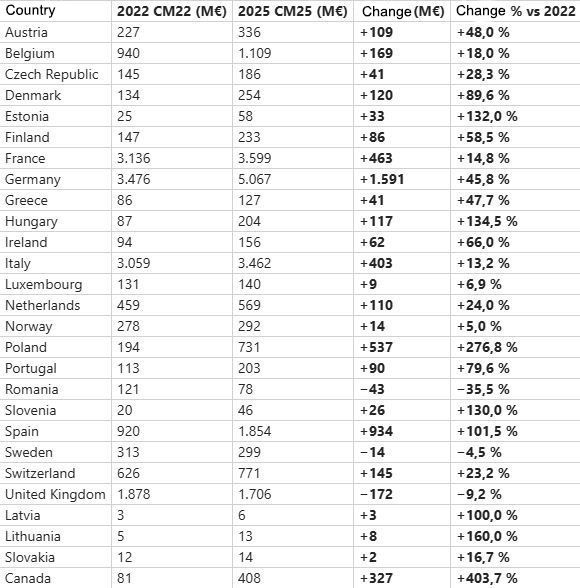
The funding distribution reveals significant geographic shifts. Germany’s contribution increased sharply from €3.47 billion to just over €5 billion, now representing 23.11% of total agency funding. The United Kingdom experienced the steepest decline, dropping from 11.2% to 7.7% of total contributions (€1.878 billion to €1.706 billion), falling to fifth place behind Spain. Despite this reduction, the UK secured continuation of the Rosalind Franklin Mars rover, built by Airbus in the UK and scheduled for 2028 launch.
𝐓𝐡𝐞 𝐏𝐚𝐭𝐡 𝐅𝐨𝐫𝐰𝐚𝐫𝐝 𝐑𝐞𝐪𝐮𝐢𝐫𝐞𝐬 𝐈𝐧𝐭𝐞𝐫𝐧𝐚𝐥 𝐑𝐞𝐟𝐨𝐫𝐦
With this clear mandate, ESA must transform itself to match the pace of the New Space economy. Recruitment practices that prioritize contractors through third-party agencies, coupled with large contract allocation favouring established incumbents over innovative start-ups, continue drawing criticism. Processes, recruitment practices, contract award criteria, and contract negotiations all need reform for Europe to realize the full potential of this historic investment.
𝐇𝐢𝐬𝐭𝐨𝐫𝐢𝐜 €22.1 𝐁𝐢𝐥𝐥𝐢𝐨𝐧 𝐄𝐒𝐀 𝐅𝐮𝐧𝐝𝐢𝐧𝐠 𝐂𝐨𝐦𝐞𝐬 𝐰𝐢𝐭𝐡 𝐚 𝐂𝐡𝐚𝐥𝐥𝐞𝐧𝐠𝐞: 𝐓𝐫𝐚𝐧𝐬𝐟𝐨𝐫𝐦 𝐨𝐫 𝐅𝐚𝐥𝐥 𝐁𝐞𝐡𝐢𝐧𝐝