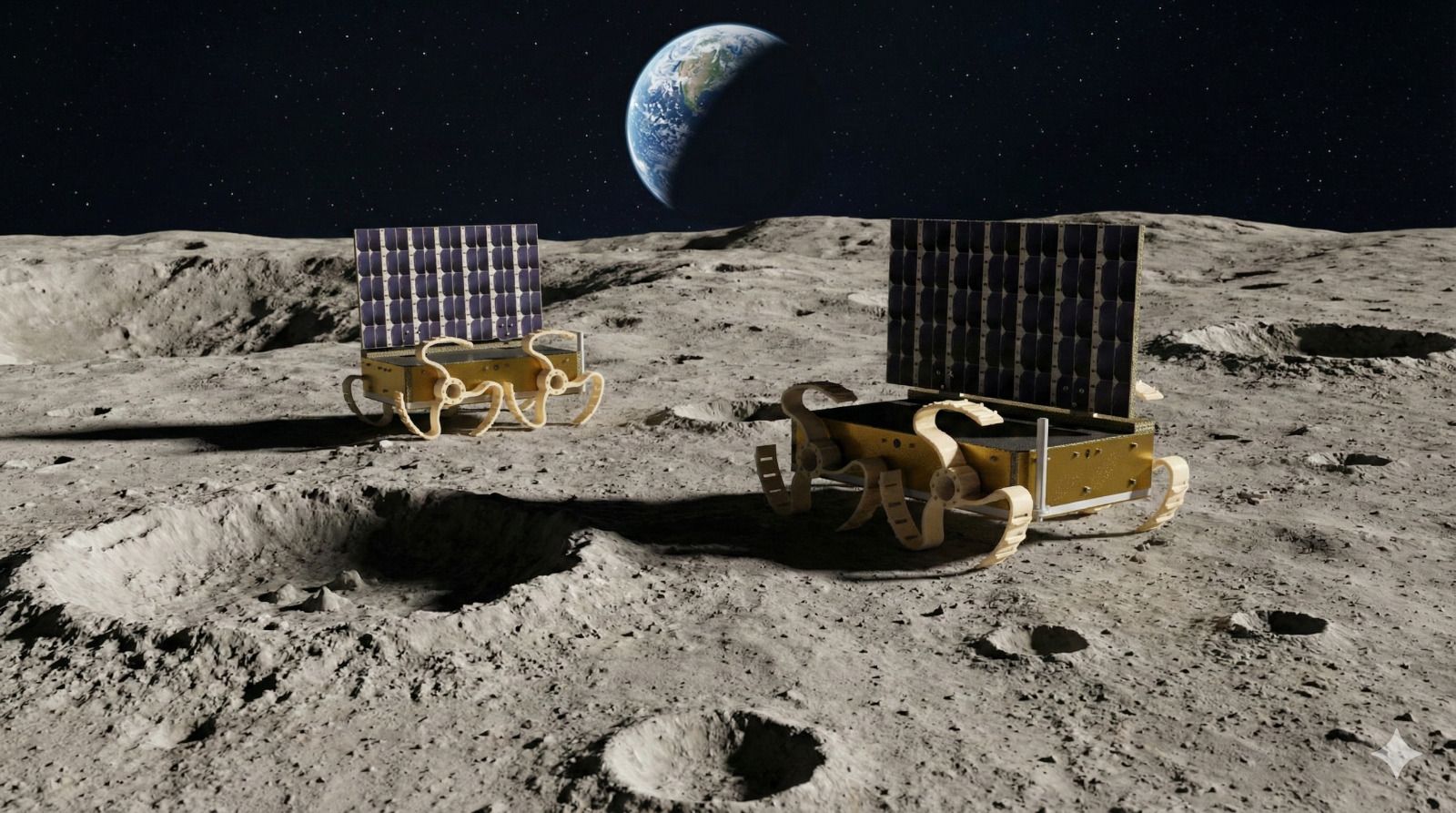
Orta Doğu Teknik Üniversitesi / Middle East Technical University (METU) is preparing to make space history: In 2029, Türkiye could become the first nation to land and autonomously operate two rovers simultaneously on the lunar surface. The CHERI (CHallenging environments Exploration Rovers for Intelligence – also a namesake for Çeri, which means soldier in Turkish) mission will deploy two autonomous micro-rovers to the Moon’s South Pole aboard China’s Chang’e-8 mission in 2029. This would position Türkiye as the sixth nation to operate rovers on the lunar surface, joining the United States, Russia, China, Japan, and India, while pioneering a new capability in coordinated robotic exploration.
Each CHERI rover weighs less than 5 kilograms, roughly the size of a shoebox, yet these compact AI-operated rovers are designed to operate in extreme conditions where temperature swings exceed 200°C, and sunlight arrives intermittently. The mission targets a landing near Mons Mouton (Leibnitz Beta)—a region where permanently shadowed areas contain potential cold traps for water-ice and other volatiles.
What distinguishes CHERI from previous lunar surface missions is the coordinated operation of two independent rovers working simultaneously. This dual-rover approach enables stereoscopic 3D mapping of the terrain and allows testing of different mobility systems in parallel—capabilities that support more robust exploration strategies for future missions.
The Chang’e-8 lander has many scientific objectives, including demonstration of in-situ resource utilization (ISRU) by 3D printing structural elements from lunar regolith. These experiments directly support China’s International Lunar Research Station (ILRS) vision for a robotic research base that will eventually accommodate human crews in the 2030s. The ILRS represents an alternative framework to the US-led Artemis program (which Türkiye has not joined yet), positioning itself as an open, collaborative scientific enterprise.
For METU, the CHERI mission marks more than a technical achievement—it establishes operational experience in coordinated robotic systems and international space mission partnerships. METU Rector Prof. Dr. Ahmet Yozgatlıgil emphasized that the mission reflects both national ambition in space research and a commitment to international scientific cooperation, aiming to build a competitive and innovation-driven ecosystem for the emerging space nation.
Two Rovers, One Historic First: Türkiye’s METU to Pioneer Dual Lunar Rover Operations in 2029