


There is currently no Global Navigation Satellite System (GNSS) on Mars. For fast-moving, wind-driven Tumbleweed rovers, that matters because science data is only useful if we know exactly where it was collected. How do you tag measurements with accurate position and heading without satellite positioning or a heavy sensor payload?
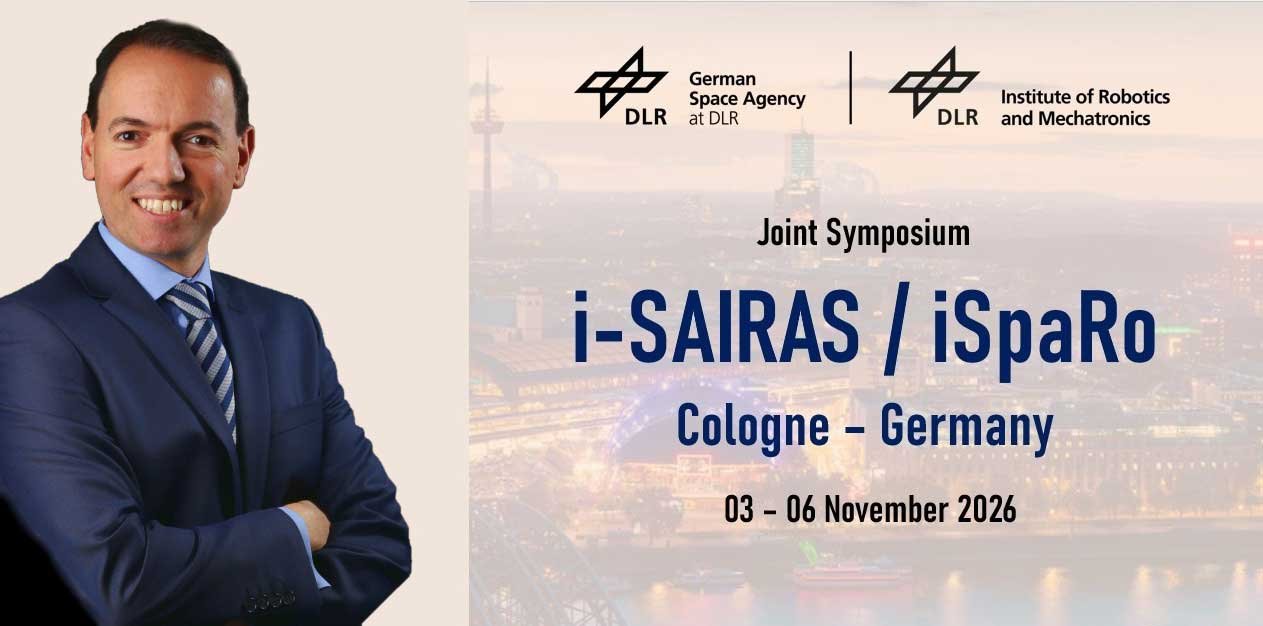
This November, I will present the answer our Tumbleweed Mars R&D team has been working on at iSpaRo, held jointly for the first time with i-SAIRAS at the Confex conference and exhibition center in Cologne, Germany, from 3 to 6 November 2026.
Our peer-reviewed paper, “Encoder-Aided Inertial Navigation and Visual Odometry Validation for Wind-Driven Mars Rovers”, introduces PESTO (Pose Estimation via Sensor Tracking and Odometry). A Tumbleweed rover has an outer shell that rotates and an inner payload structure that stays fixed. PESTO is an encoder-aided two-dimensional extended Kalman filter that estimates horizontal position, velocity, heading and inertial biases. It builds on established sensor fusion and adapts it to Tumbleweed’s mechanics: a rotary encoder measures the rotation between the inner and outer shell, and our algorithm corrects the estimated forward speed. Our contribution is this specific algorithm, plus controlled simulation tests showing how much the correction reduces position drift for a wind-driven rover.
The result: PESTO reduced mean position error by more than 70% compared to non sensor fusion over a mean traverse length of 544 m. These are synthetic conditions, so the study validates the encoder update itself, which is the foundation for the next steps. Full validation requires synchronised IMU, encoder, camera, attitude and independent ground-truth data.
This is a team effort. Huge thanks to my co-authors Giovanni Cozzolongo, Tim Holthuijsen and James Kingsnorth.
iSpaRo is a young conference, started in 2024. It exists to fill the gap between established robotics conferences and non-peer-reviewed aerospace events, bringing researchers and industry together. Space robotics is the enabler of the New Space economy and of expansion beyond Earth, and I am glad to be part of it. If you are attending in Cologne and working on space robotics, navigation or autonomy, come and say hello.