


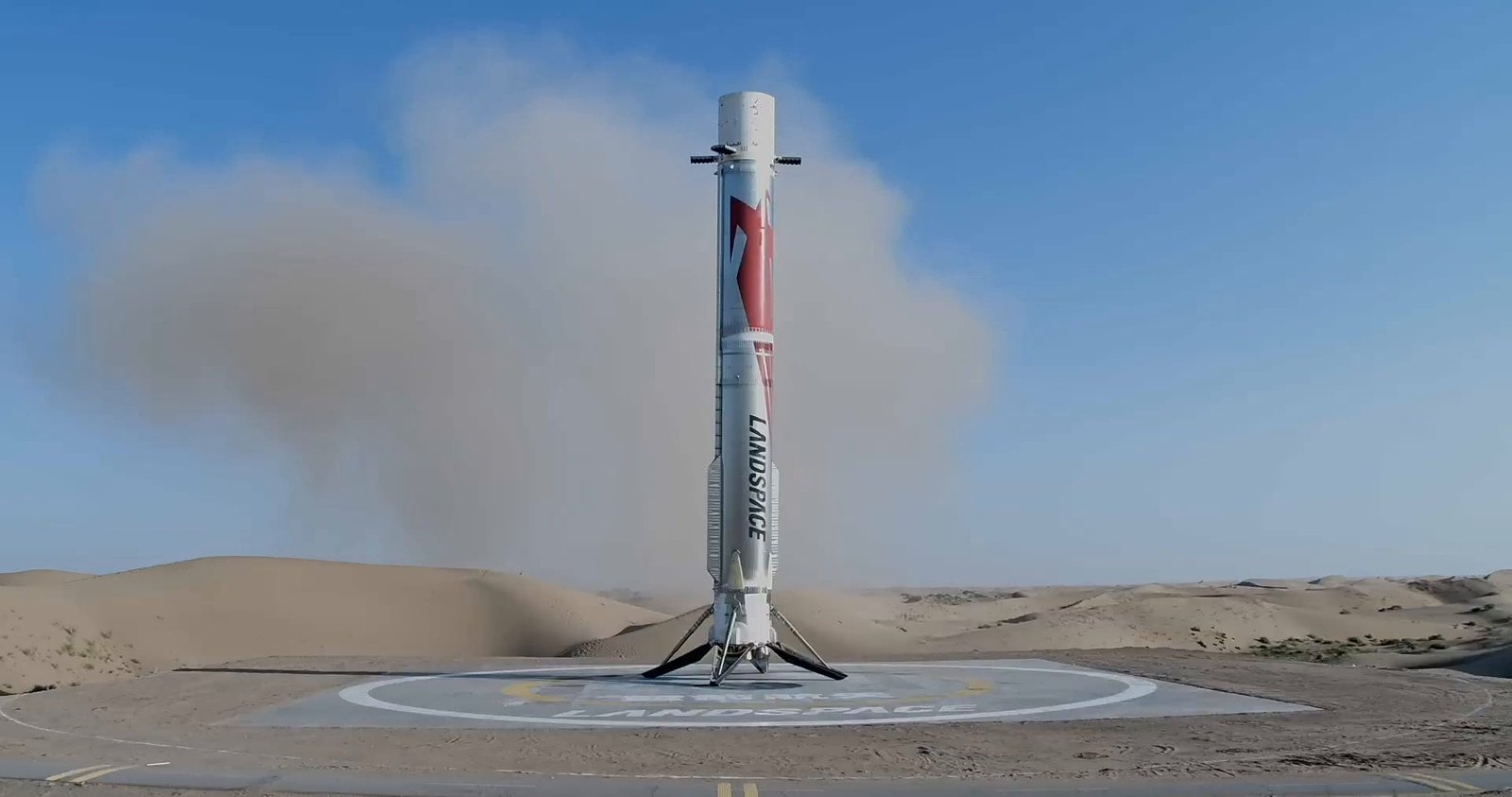
On August 18, the two-stage Zhuque-3 lifted off from the Gobi Desert, launching from Jiuquan Satellite Launch Center, China. The stages separated 137 seconds into flight. The first stage then flew a powered descent, deployed its landing legs in the final moments of the burn, and touched down softly about 390 kilometers downrange.
Landspace is now the third entity in the world, after SpaceX and Blue Origin, to land an orbital booster on legs. Zhuque-3 is the first stainless steel rocket to do it. And this is China’s second successful booster recovery in just over a month, following the state-owned Long March 10B, which used a drone ship and a net capture system at sea in July. Two different methods, five weeks apart.
The first Zhuque-3 flight, on December 3 2025, reached orbit but lost its booster during the final phase of landing, China’s first attempt at recovering an orbital stage. State-run China Aerospace Science and Technology Corporation (CSTC) tried and failed, with the Long March 12A, weeks after that too. Landspace got it right this time after CSTC succeeded as well.
The Zhuque-3 rocket is about 66 meters tall, 4.5 meters in diameter, and runs on methane and liquid oxygen (methalox) through nine Tianque engines on the first stage. That fuel choice is a Landspace signature: its earlier Zhuque-2 was the world’s first methane powered rocket to reach orbit. Zhuque-3 can lift 21 tons to Low Earth Orbit (LEO) expendable, or 18.3 tons with the booster recovered, close to Falcon 9’s 22.8 tons. Landspace says the mission moves it from verifying recovery technology to engineering scale reuse, with another flight targeted for later this year. The result also lands well for the company’s pending IPO on Shanghai’s STAR Market.
Three companies can now land a booster on legs, versus one a year ago. The circle of nations reaching orbit is widening too: India recently logged its own first successful New Space orbital launch, a milestone worth celebrating. Europe stands out as the holdout, with well-funded New Space firms there still working toward their first orbital launch. After all, launches are the enabler of the New Space economy: a more competitive launch market means lower costs and faster infrastructure buildout, and having your own launcher means less dependence on other countries to get there.
China’s Landspace recovers booster with second orbital launch of Zhuque-3 rocket
Zhuque-3 rocket wiki
https://en.wikipedia.org/wiki/Zhuque-3
First Operational Methane-Powered Rocket is Zhuque-2 Launcher