


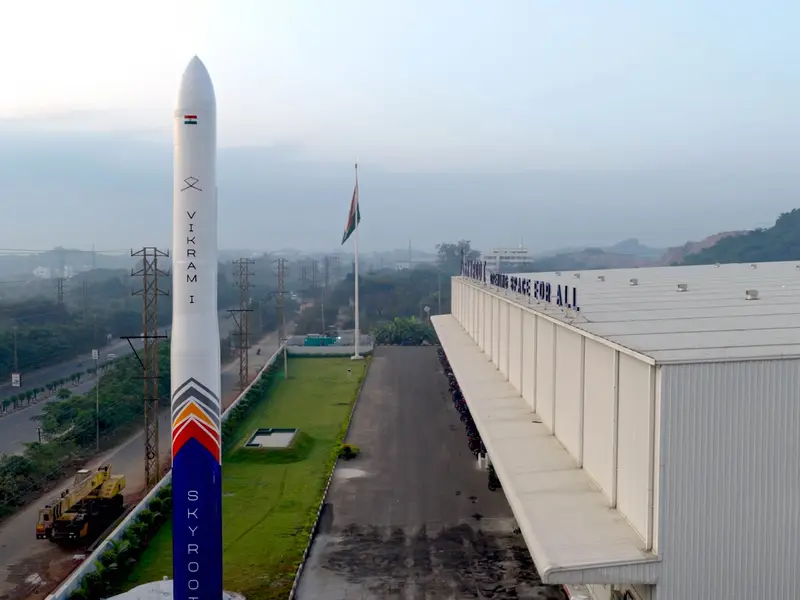
Skyroot Aerospace has just become India’s first space unicorn, valued at $1.1 billion following a $60 million funding round announced on 7 May 2026. The timing is no coincidence — Vikram-I, the companies privately built orbital rocket, is already at the launch pad at the Satish Dhawan Space Centre and weeks away from attempting to place satellites into orbit for the first time. If it succeeds, it could mark the moment India’s private sector entered the commercial small satellite launch market, with a cost structure that few competitors can match.
Skyroot was founded in 2018 by Pawan Kumar Chandana and Naga Bharath Daka, two former ISRO scientists who started India’s first private rocket company with a small team, limited capital, and an ambitious vision. Today, they operate a 200,000 sq ft rocket factory with over 1,000 staff.
The company’s goal is straightforward: deliver the most affordable, on-demand small-lift access to orbit. Their Vikram launch vehicle series — named after Dr. Vikram Sarabhai, father of the Indian space programme — is designed for flexibility and rapid turnaround, targeting the growing small satellite market.
In 2022, Skyroot raised $51 million in one of India’s largest space-tech funding rounds, led by GIC. The latest $60 million round brings total funding to $160 million. A MoU with the Telangana state established India’s first integrated rocket manufacturing, integration, and testing facility in Hyderabad, backed by a ₹500 crore investment.
Vikram-I is a four-stage rocket standing 26 metres tall, capable of lifting 350 kg to Low Earth Orbit. It uses 3D-printed Raman engines that cut engine weight by nearly half and reduce production time by around 80 percent. Built from carbon composite materials, it is lighter, cheaper, and faster to produce than conventionally built rockets.
The new funding will also support development of Vikram-2, a cryogenic upper stage vehicle targeting 900 kg to LEO, with a first launch as soon as 2027. None of this would have been possible without India’s 2020 space sector reforms. The creation of the Indian National Space Promotion and Authorization Centre (IN-SPACe) opened the market to private players, and Skyroot has been among the first to step up.
What Skyroot represents is bigger than one rocket. India has long competed on cost for equal quality — and the small satellite launch market may be next.
Image Credit: Skyroot Aerospace – A model of the 75-feet-tall Vikram-1 rocket at Skyroot’s Hyderabad facility