


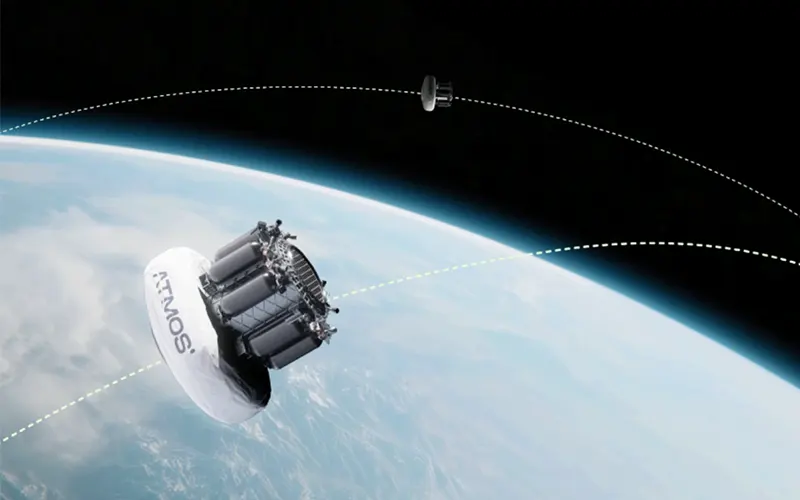
European orbital return is moving from milestone to routine. ATMOS Space Cargo, a German company developing orbital re-entry vehicles, has closed a €25.7 million Series A round, co-led by Balnord and Expansion, with participation from Keen Defence and Security and the European Innovation Council through its Accelerator blended financing programme.
The funding did not arrive on the back of promises alone. ATMOS flew its PHOENIX 1 demonstrator in April 2025, collecting data on its Inflatable Atmospheric Decelerator (IAD) technology — a non-ablative system that functions simultaneously as heat shield and aerodynamic brake during re-entry. Investors backed a team that had already reached orbit. That distinction matters in a crowded field where start-ups want large investments well ahead of any hardware reaching orbit.
Building the First Routine European Return Infrastructure
The primary use of funds is the construction and operation of three PHOENIX 2 orbital transfer and return vehicles (OTRVs). Each vehicle is a free-flying spacecraft capable of missions lasting from a few hours to several months in Low Earth Orbit. The inaugural PHOENIX 2 is already on a defined path to flight: a rideshare launch aboard a SpaceX Falcon 9 is planned for 2026.
The mission brings together two complementary operational layers. ATMOS will handle launch integration, orbital mission control, telemetry, autonomous de-orbit, re-entry, and recovery near Santa Maria in the Azores, under Portugal’s commercial re-entry licence. Sitting above that infrastructure is BentoBox — a payload operations platform designed and operated by Space Cargo Unlimited — which equips PHOENIX 2 with a controlled, service-oriented environment for commercial and research users. Together, the two systems form an integrated end-to-end service for customers flying hardware to and from orbit.
Scaling Up: PHOENIX 3 and ATMOS WORKS
Looking further ahead, ATMOS has begun developing PHOENIX 3, targeting up to one metric tonne of payload capacity — roughly ten times that of PHOENIX 2 — to serve aggregated multi-customer missions and institutional requirements. ATMOS WORKS will operate as a dedicated subsidiary for governmental and defence customers, rounding out what the company describes as a full architecture spanning commercial, institutional, and defence applications.
For Europe, the significance extends beyond one company’s roadmap. ATMOS represents a meaningful step toward sovereign capsule return capability — the ability to access, operate in, and return hardware and materials from orbit independently, under European jurisdiction. Yet perhaps the most underappreciated aspect of what ATMOS is attempting is not the technology itself, but the cadence. PHOENIX 1 has been a demonstration — a carefully executed first step. No organisation has yet turned the journey to orbit and back into something repeatable and reliable. If ATMOS can deliver on that, it will not just be an encouraging signal for the company — it will mark a genuine step change in the maturity of the European New Space economy.
Image credit: ATMOS Space Cargo
ATMOS Space Cargo Raises €25.7 Million in Series A to Build Europe’s Orbital Return Infrastructure
https://www.linkedin.com/pulse/atmos-space-cargo-raises-257-million-series-build-europes-oezdf
ATMOS Space Cargo Raises €25.7 Million to Begin Space Return Operations
Space Cargo Unlimited and ATMOS Space Cargo Target 2026 Launch For First of Seven Autonomous Manufacturing Missions to Low Earth Orbit
ATMOS Space Cargo Conducts FirstRe-Entry Mission from Space early on its way to building a leading return logistics platform with its Innovative Return Capsule