


NASA’s Artemis II mission is making history with the first crewed flight to the Moon in more than half a century. Four astronauts embarked on a 10-day mission around the Moon aboard the Orion spacecraft, launched from Kennedy Space Center, Florida, USA. Building on Artemis I — the uncrewed test flight of Orion and the Space Launch System (SLS) rocket in November 2022 — Artemis II marks the programme’s first mission with crew aboard.
Orion, paired with SLS, is designed to carry astronauts not only to the lunar surface but toward deeper destinations, including Mars. The spacecraft comprises two key elements: NASA’s crew module, which sustains astronauts throughout the journey and shields them from space radiation; and the European Service Module (ESM-2), developed by Airbus for ESA, which provides propulsion, power, thermal control, and life support — water and air — while connected to the crew module.
Artemis II is demonstrating Orion’s life-support systems, navigation, and communications with astronauts onboard for the first time — laying the foundation for humanity’s return to the lunar surface. The mission will take crew members closer to the Moon than any human has been in over fifty years, and further from Earth than ever before.
Artemis III will see a crew launch in Orion on the SLS rocket for the second time. In Earth orbit, the crew will test rendezvous and docking capabilities between Orion and private commercial spacecraft needed to land astronauts on the Moon — involving SpaceX, Blue Origin, or both, the commercial partners selected to develop the lunar landers. Artemis IV, currently planned for 2028, is targeted as the first lunar landing mission.
The Thirst for Discovery
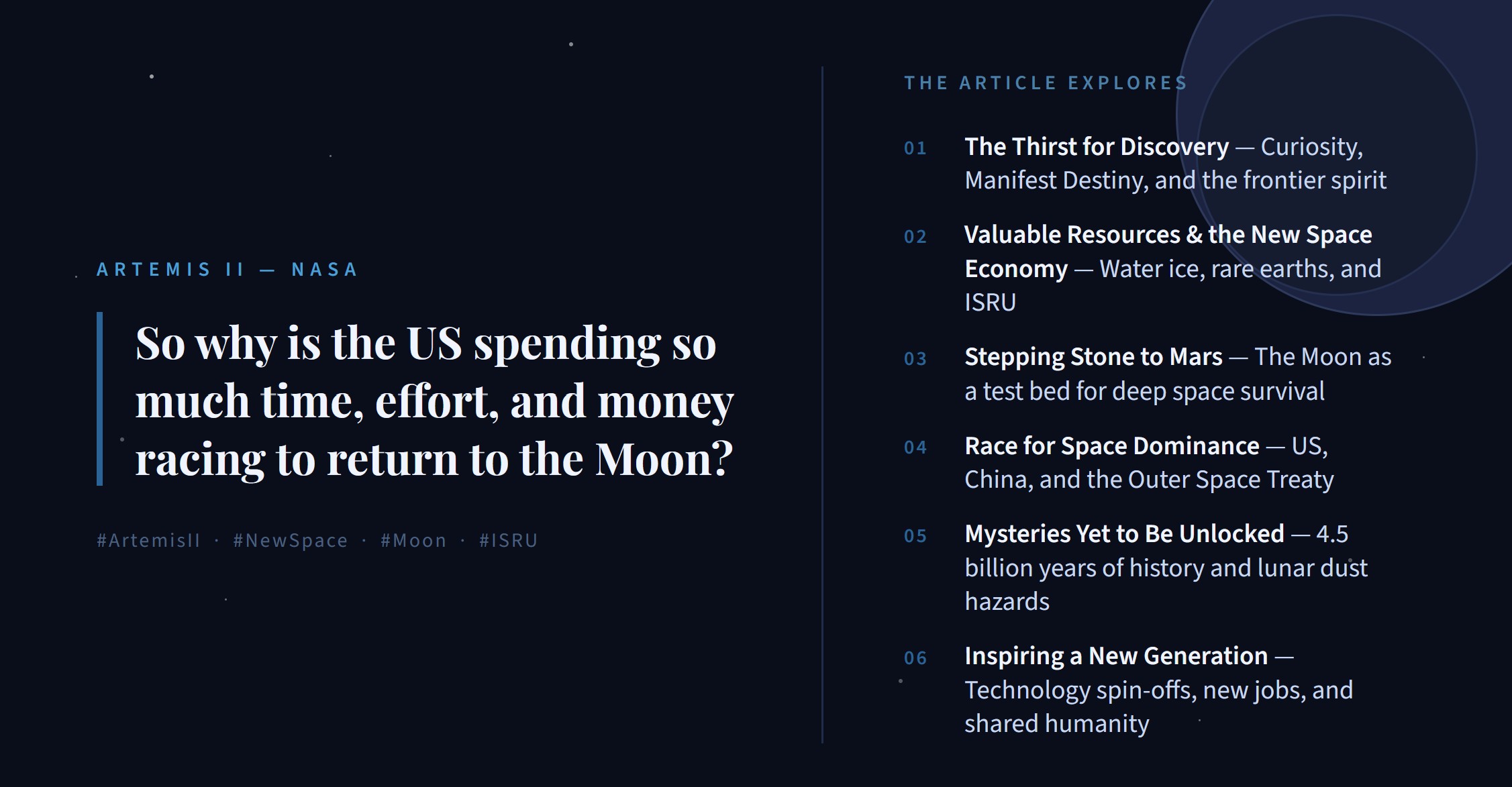
So why is the US spending so much time, effort, and money racing to return? Exploration is woven into the human story — though if we are honest, it has rarely been driven by curiosity alone. America has its own controversial word for it. Manifest Destiny — the nineteenth century belief that Americans were destined to push westward, in pursuit of new territory and opportunity — shaped much of the nation’s early character and ambition. Space is the natural continuation of that spirit. For the United States, that impulse carries particular cultural weight — a frontier to push beyond, new territory to reach and ‘conquer’. And again, the frontier happens to come with some valuable resources. Curiosity and pragmatism, it turns out, have always made good travelling companions.
Valuable Resources and the New Space Economy
The lunar terrain might look dry, dusty, and barren, but it is far from that. The Moon holds the same elements found on Earth — among them rare earth elements, scarce on our planet but potentially concentrated enough on the lunar surface to extract. There are metals too, including iron and titanium, as well as helium, used in everything from superconductors to medical equipment. But the resource drawing the most attention is perhaps the most surprising: water. Trapped in minerals and concentrated in permanently shadowed craters at the poles, lunar water ice can provide drinking water, be split into hydrogen and oxygen for breathable air, and even converted into rocket propellant — making it foundational to any sustained human presence on the Moon.
This is where the emerging New Space economy becomes central to the story. Today’s lunar ambitions are transforming exploration from a purely government-led endeavour into a broader ecosystem of national agencies and commercial companies, united around a compelling logic: In-Situ Resource Utilisation, or ISRU. Rather than launching everything from Earth at enormous cost, ISRU means extracting and processing what is already present on the lunar surface. Every kilogram not launched from Earth reduces mission costs substantially — and it is ISRU that transforms the Moon from a destination into a launching platform for deeper space exploration, and ultimately Mars.
Stepping Stone to Mars
The Artemis programme’s ambition is clear: establish a sustained human presence on the Moon as a stepping stone to Mars. Going to the Moon and remaining there for an extended period is widely regarded as safer, cheaper, and more practical as a test bed for learning how to live and work on another planet. On a lunar base, astronauts and engineers will need to work out how to generate power, build habitats capable of withstanding extreme temperature swings, and protect crews from dangerous space radiation — challenges that are formidable on the Moon but potentially mission-ending on Mars — there is no rescue mission, no quick return, and no margin for error. Astronauts are trained extensively for mishaps, but even the most rigorous preparation has limits when you are 225 million kilometres from home. In the movie The Martian, Mark Watney managed it with potatoes and sheer stubbornness, but NASA would rather not make that the plan. The Moon offers a far more forgiving environment — close enough to Earth that, in a worst-case scenario, international rescue missions remain a genuine possibility.
Race for Lunar Dominance
The original Apollo missions of the 1960s and 1970s were driven by competition with the Soviet Union. This time around, China is the benchmark. China has been making fast progress — successfully landing robots and rovers on the Moon and stating its intention to get humans there by 2030. There is still prestige in being first, but now it also matters considerably where you plant your flag. Both the US and China are focused on the areas with the most abundant resources and the most strategically valuable lunar real estate.
The United Nations 1967 Outer Space Treaty establishes that no country can own the Moon. But the picture is more nuanced when it comes to what is found there. While you cannot own a piece of lunar land, you can operate on it without interference — and once established, you hold that position for as long as you choose to remain.
Mysteries Yet to Be Unlocked
The rocks brought home by the Apollo astronauts transformed our understanding of the Moon — revealing, among other things, that it was formed when a Mars-sized body collided with the early Earth. Yet much remains to be discovered. Because the Moon was once part of the Earth, it holds a record of 4.5 billion years of our own planet’s history. With no plate tectonics, no wind, and no rain to erode that record, the lunar surface is in many respects a perfect time capsule. A new collection of rock samples from a different region of the Moon could yield insights into Earth’s own deep history that no amount of terrestrial geology can provide.
The Apollo missions also offered an early warning about one of the Moon’s less obvious hazards. Lunar dust — the layer of soil and fragmented rock covering the surface — has never been exposed to water, oxygen, or weathering, leaving its particles sharp, abrasive, and highly electrostatically charged. Constantly bombarded by solar radiation in the absence of any atmosphere, the lunar surface builds up a charge strong enough to cause dust to levitate above the ground, allowing it to penetrate gaskets, seals, and equipment with relative ease. NASA’s Kennedy Space Center has spent years developing Electrodynamic Dust Shield technology specifically to address this issue.
Inspiring a New Generation
History has shown that major space endeavours act as catalysts for technological progress with tangible returns on Earth. The R&D underpinning Artemis will likely yield a further wave of technologies that benefit life on Earth — and the New Space economy it is catalysing will generate jobs, investment, and commercial activity well beyond the space sector itself.
The grainy black-and-white footage of the Apollo missions turned the dream of space into something real for an entire generation, many of whom went on to careers in science, engineering, and technology. Artemis II will be streamed live and the audience watching will be larger, younger, and more globally connected than ever before.
In a world where conflict continues to exact a devastating human toll — fuelled by differences of religion and ideology that are, at their core, human constructs — Artemis offers a different lens. When we direct our energy toward science and what we have in common rather than the divisions we have manufactured, we move further, literally and figuratively — and offer a glimpse of what our species is truly capable of when we work together.
References:
Artemis II: Why is Nasa sending people back to the Moon?
https://www.bbc.com/news/articles/cd6wp6xenv0o
Orion European Service Module
Artemis II: Why we are going back to the Moon and why it matters
Artemis III
Orion Crew Module
https://sacd.larc.nasa.gov/vab/vab-projects/orion-crew-module