


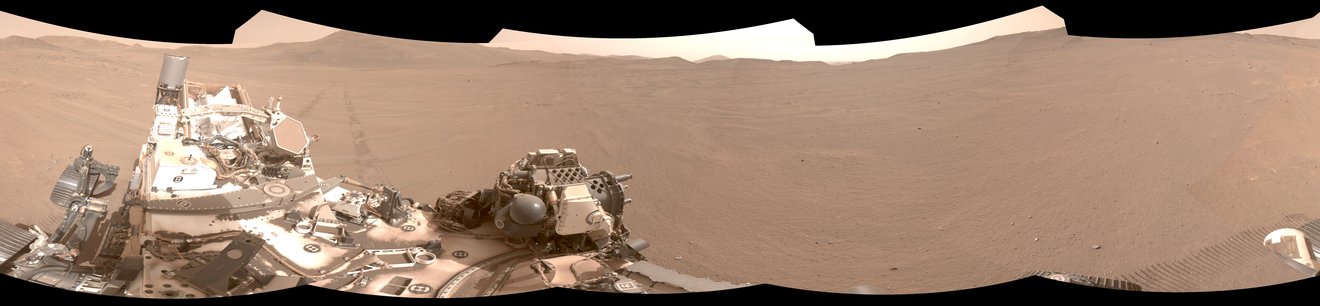
For five years, NASA’s Perseverance rover has been driving across the Martian surface with a fundamental constraint: it couldn’t reliably know its own precise location. With no Global Navigation Satellite System (GNSS) orbiting the Red Planet, mission operators on Earth had to manually match rover panoramas to orbital imagery from NASA’s Mars Reconnaissance Orbiter (MRO) after each long drive, a process taking over 24 hours just to confirm a position accurate to within 35 meters.
That bottleneck is now history.
Engineers at NASA’s Jet Propulsion Laboratory have developed what they call Mars Global Localization (MGL), an onboard algorithm that compares Perseverance’s navigation camera panoramas against stored orbital terrain maps — autonomously, in about two minutes, to within 25 centimetres accuracy. First used in live mission operations on February 2, 2026, the solution runs on the Helicopter Base Station — the hardware Perseverance originally used to communicate with the now-retired Ingenuity helicopter — rather than the rover’s two main computers. Those primary processors, built to survive the radiation-heavy Martian environment, are based on hardware introduced in 1997: dependable, but slow by modern standards. The Base Station’s commercial processor, by contrast, powered many consumer smartphones in the mid-2010s and runs more than 100 times faster — making it the pragmatic choice for the computationally demanding task of image matching.
The operational impact for Perseverance is immediate. Its AutoNav self-driving system was already capable of navigating around obstacles autonomously; positional uncertainty was the limiting factor on drive distance. Using dead reckoning, Perseverance estimates its position by tracking movement from a last known location — fusing Visual Odometry and Inertial Measurement Unit data. Small errors from wheel slip and imperfect feature tracking accumulate with every metre driven, and on long drives that drift becomes significant enough to force a halt. Rather than waiting over 24 hours for Earth operators to confirm its position, MGL resets the accumulated error autonomously in under two minutes — and Perseverance drives on.
JPL robotics engineer Jeremy Nash, who led the project, described it as solving “an open problem in robotics research for decades, and it’s been super exciting to deploy this solution in space for the first time.” It is a pattern we have seen before: the demands of operating in the most unforgiving environments imaginable push engineers to develop solutions that eventually find their way back to Earth. Space exploration has long been a catalyst for practical innovation, and this panoramic image matching is another example.
Image Credit: NASA JPL
NASA’s Perseverance Now Autonomously Pinpoints Its Location on Mars
https://www.jpl.nasa.gov/news/nasas-perseverance-now-autonomously-pinpoints-its-location-on-mars
Mars Helicopter Base Station on Perseverance Rover
https://science.nasa.gov/resource/mars-helicopter-base-station-on-perseverance-rover
Mars Reconnaissance Orbiter
https://science.nasa.gov/mission/mars-reconnaissance-orbiter