


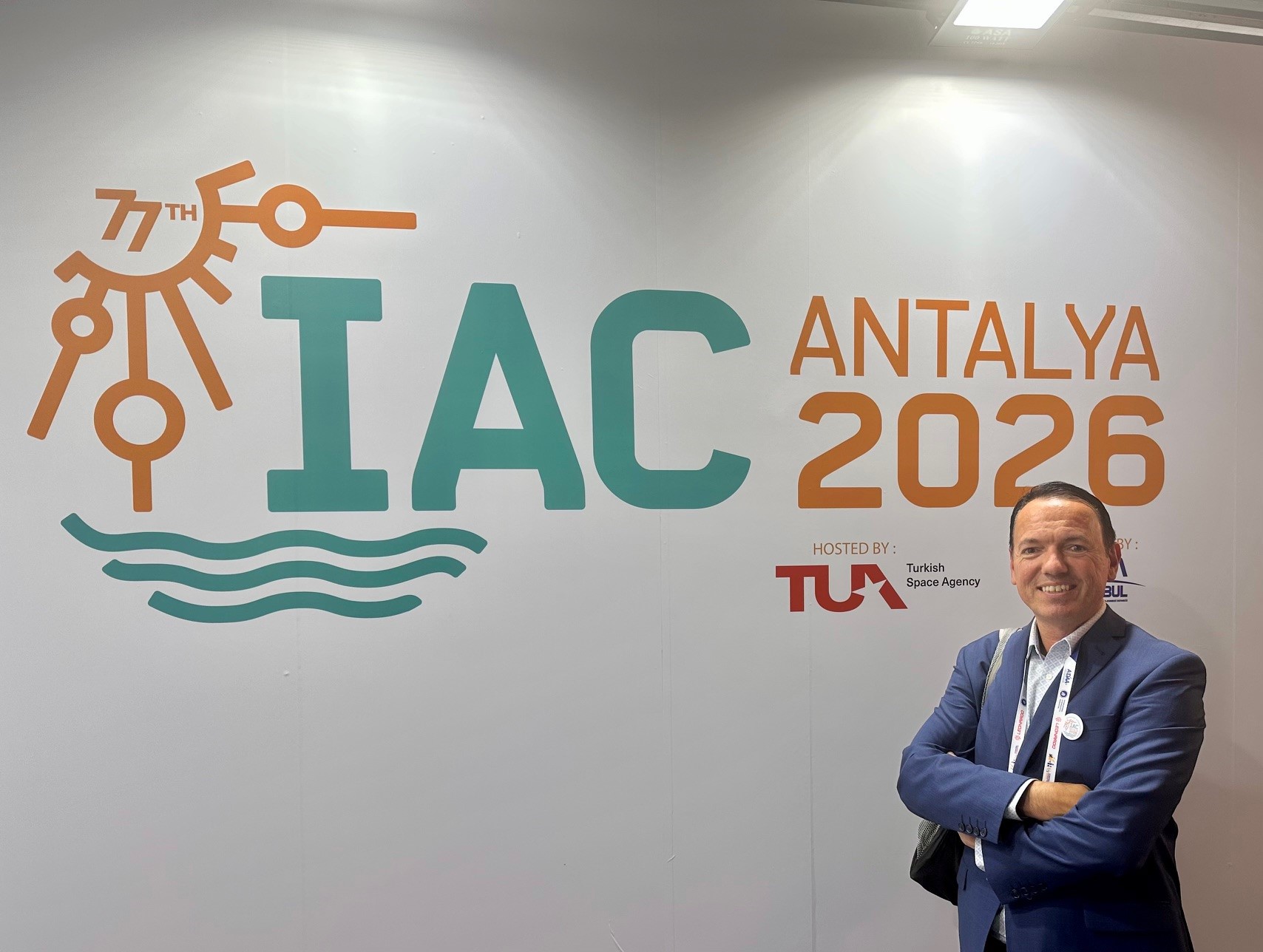
The 77th International Astronautical Congress (IAC) will take place in Antalya, Türkiye, from 5-9 October 2026. Hosted by the Turkish Space Agency (TUA), an IAF member since 2021, this edition promises collaboration, networking, and inspiration against the backdrop of the Turkish Riviera. The theme, “The World Needs More Space” underscores the boundless potential of space to advance technology, expand scientific knowledge, and drive human progress. It brings countries together to work on peaceful missions. This echoes the vision of M.K. Atatürk, founder of modern Türkiye: “Peace at Home, Peace in the World“—a principle that naturally extends to Peace in Space as nations collaborate beyond Earth’s boundaries
I predict record participation as Türkiye is a bridge between East and West as well as North and South. Add to that an easier visa regime compared to the EU and Australia as well as reasonably priced flights to Antalya and you have the perfect combination for record attendance. The abstract deadline is 28 February 2026 (23:59 CET) with a maximum of 400 words.
Since establishing the Turkish Space Agency in 2018, Türkiye has moved decisively. The 2021 National Space Program laid out an ambitious 10-year roadmap: lunar exploration, indigenous satellite technologies, and a regional positioning and timing system. Just three years later, that ambition became tangible when Alper GEZERAVCI became Türkiye’s first astronaut, conducting 13 scientific experiments aboard the ISS—work prepared entirely by Turkish scientists and academics.
Türkiye represents an emerging space nation success story. The country has transitioned from relying entirely on major international manufacturers for its space infrastructure—purchasing telecommunications and Earth observation satellites from established industry leaders—to building its own. İMECE, designed and developed by TÜBİTAK Space (TUBITAK UZAY) and launched in April 2023, provides sub-meter resolution imagery as Türkiye’s first domestically produced Earth observation satellite. Turksat 6A followed in July 2024 as the country’s first indigenously developed communications satellite.
Together, these milestones mark Türkiye’s shift from customer to manufacturer across critical space capabilities. This transformation extends beyond Earth orbit. The centrepiece of Türkiye’s space ambitions lies 384,000 kilometers away.
Lunar Research Programme
The Lunar Research Program or Ay Araştırma Programı (AYAP) in Turkish, is the official name of Türkiye’s two-phase lunar mission to reach the Moon, managed by the Turkish Space Agency (TUA) and TÜBİTAK UZAY.
The first mission, TLM-1, will open the doors of deep space exploration and place Türkiye among the few nations to reach the Moon, and contribute to global science and technology through scientific experiments. The development and testing of the indigenous spacecraft and the national hybrid propulsion system are currently underway. In the second Turkish Lunar Mission (TLM-2), Türkiye aims to land a spacecraft on the surface of the Moon using domestically developed technologies.
With a 30% budget increase for space activities, Türkiye has the opportunity to grow its space economy through partnerships, policy evolution, and private sector engagement. Let’s meet at IAC26 in Antalya this October to collaborate.
References:
The Mission, Science and Technology Objectives of the First Turkish Lunar Mission, Burak Yaglioglu et al, Global Space Exploration Conference (GLEX), New Delhi, India, 7-9 May 2025
https://iafastro.directory/iac/archive/browse/GLEX-2025/2/2/93595
IAC 26 Space in Turkiye
https://www.iac2026.org/space-in-turkiye
Turkish National Space Program:
https://cdn.tua.gov.tr/60b61f993ada2.pdf
Türkiye’s space future: An ambitious path ahead
Türkiye ascends to space: A new global player emerges
https://www.dailysabah.com/opinion/op-ed/turkiye-ascends-to-space-a-new-global-player-emerges