


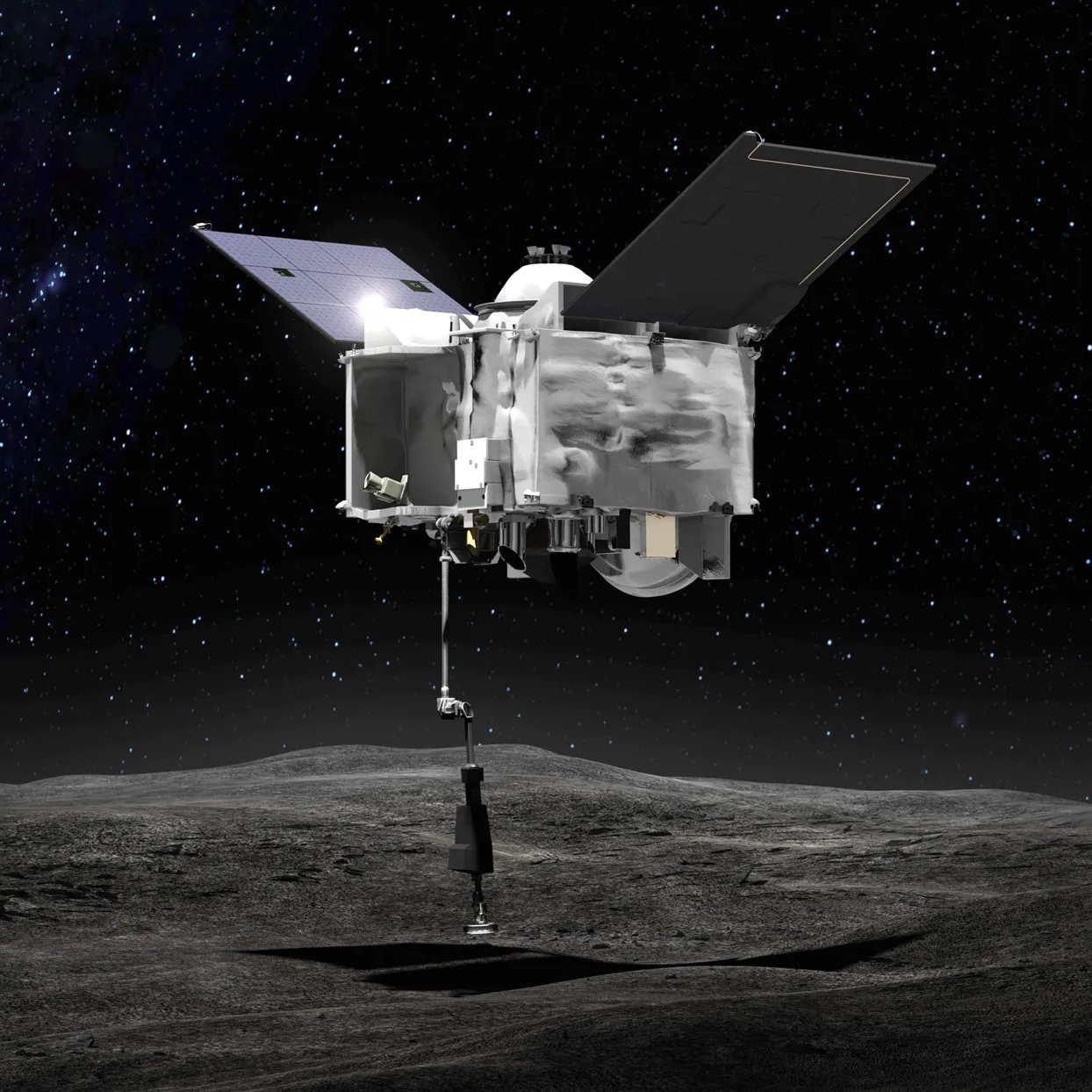
@NASA’s Origins, Spectral Interpretation, Resource Identification, and Security – Regolith explorer (OSIRIS-Rex) spacecraft made history on the 24th September 2023, by successfully delivering a sample from the near-Earth asteroid Bennu to our planet. This achievement marks a significant milestone in planetary science, as it provides researchers with pristine asteroid material to study, offering more insights to the formation of our solar system and the origins of life on Earth.
The OSIRIS-REx mission, which launched in September 2016, spent over two years orbiting and mapping Bennu’s surface before attempting a touch-and-go maneuver in October 2020. During this brief encounter, the spacecraft collected 70.3 grams of dust and pebbles from the asteroid’s surface, far exceeding the mission’s minimum requirement of 2 ounces (60 grams).
After securing the sample in its return capsule, OSIRIS-REx began its 2.5-year journey back to Earth. The spacecraft released the capsule on September 24, 2023, which then descended through Earth’s atmosphere and parachuted safely to the surface of the Utah Test and Training Range.
The successful return of the Bennu sample is a testament to the ingenuity and perseverance of the mission team, who overcame numerous challenges, including the unexpectedly rocky surface of the asteroid. The mission’s success also highlights the importance of international collaboration in space exploration, as OSIRIS-REx joins Japan’s Hayabusa2 mission in returning asteroid samples to Earth. https://www.linkedin.com/posts/tolgaors_solarsystemorigins-spaceexploration-planetaryscience-activity-7198957110338998272-3uAS
As scientists begin to study the recovered material, they hope to unravel the mysteries surrounding the early formation of our solar system and the role that asteroids like Bennu may have played in the emergence of life on our planet. When it delivered the sample of asteroid Bennu to Earth, the OSIRIS-REx spacecraft had completed its primary mission. But the spacecraft, didn’t land back on Earth. It is continuing on to a new mission with a new name – OSIRIS-APEX (OSIRIS-Apophis Explorer) – the spacecraft will explore Apophis, an asteroid roughly 1,200 feet (roughly 370 meters) in diameter that will come within 20,000 miles (32,000 kilometers) of Earth in 2029.