


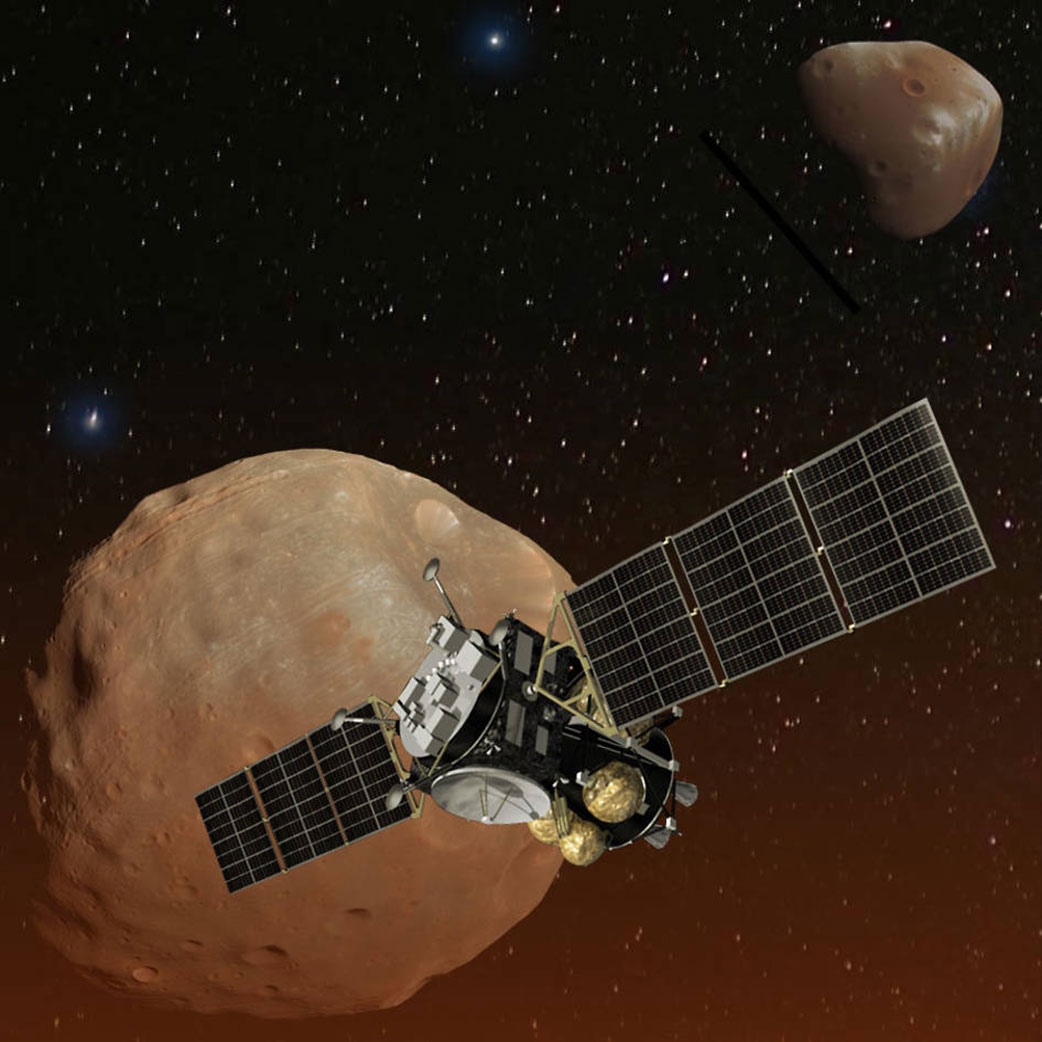
The @Jaxa-led Martian Moons eXploration (MMX) mission, scheduled for launch in 2026, is an ambitious project aimed at exploring Mars’ two moons, Phobos and Deimos. This mission will not only study these enigmatic satellites but also attempt the first-ever sample return from the Martian moon Phobos.
A primary scientific goal of MMX is to clarify the origin of the Martian moons. Scientists hope to determine whether Phobos and Deimos were once part of Mars or if they have a different origin. This investigation is crucial for understanding the formation and evolution of the Martian system.
Upon reaching Martian space, the spacecraft will enter an orbit around Mars before transitioning to a Quasi Satellite Orbit (QSO) around Phobos. From this vantage point, MMX will collect scientific data and, most importantly, gather a sample from Phobos’ surface. The sample return aspect of the mission is particularly significant. After collecting material from Phobos, the spacecraft will begin its journey back to Earth, carrying this precious cargo for detailed analysis.
Beyond its primary objectives, MMX aims to advance technologies crucial for future planetary exploration. These include:
- Transmit images from the Martian sphere with the Super Hi-Vision (SHV) cameras.
Jointly developed by @NHK and@JAXA, the two SHV cameras will capture 4K and 8K resolution images of Mars and its two moons. - The surface of Phobos is expected to be covered with meteorite fragments originating from the surface of Mars. Mars meteorite material likely be gathered in the sample collected from Phobos.
- MMX will also perform the first detailed observations of the surface topology, ground conditions, and surrounding environment of Phobos, which is considered a possible site for a human base as a natural space station.
Europe’s contribution to the mission, the MMX rover, named IDEFIX, is a collaborative effort between @DLR and @CNES. This small rover will play a crucial role in the mission by providing important findings in preparation for the landing of the mother craft and analyzing the surface composition and texture at selected locations on Phobos. Despite the extremely low gravity on Phobos, IDEFIX is designed to move and explore the moon’s surface. The rover integrates various instruments, including a radiometer and spectrometer, developed by DLR institutes. CNES is making significant contributions with camera systems for spatial orientation and exploration on the surface as well as for the investigation of mechanical ground properties. CNES is also developing the rover’s central service module, including the on-board computer and the power and communication system.
By exploring the origins of the Martian moons and the evolution of the Martian sphere, MMX seeks to unlock key mysteries of our Solar System’s history. This mission represents a significant step in planetary science and lays the groundwork for future exploration of the Red Planet and its moons.