


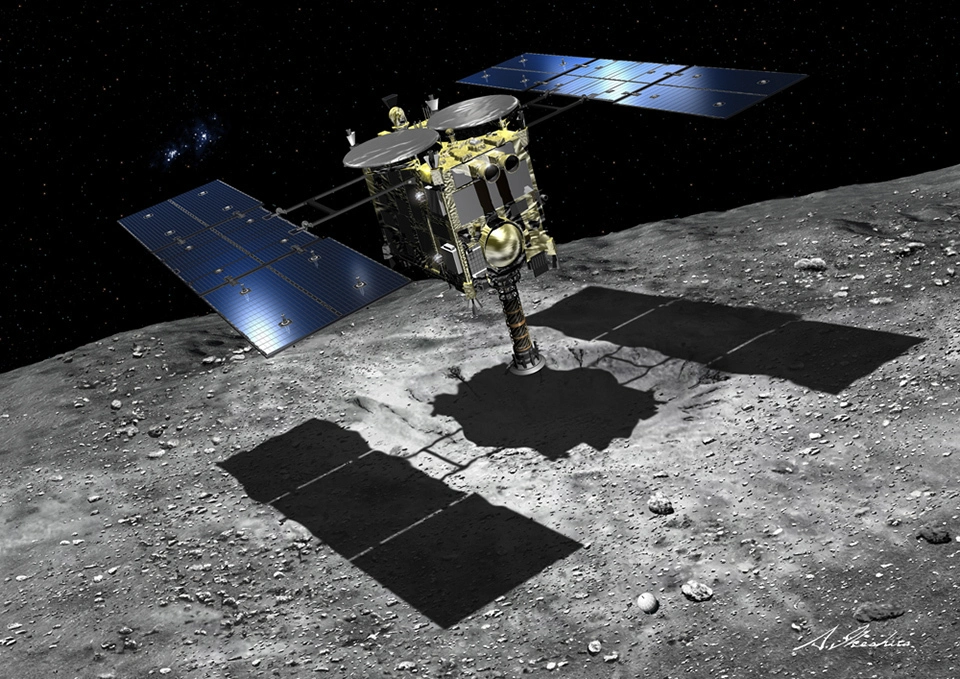
Japan’s Hayabusa2 spacecraft has found dust grains in samples from asteroid Ryugu that predate the formation of our Solar System. These pristine grains, untouched by Earth’s environment, provide an unprecedented glimpse into the early days of our cosmos.
The asteroid belongs to the most common class in our solar system, the C-type because they contain a large amount of carbon. Its orbit around the sun exists beyond Mars. Some scientists believe these types of asteroids delivered the raw materials for life to Earth, and that’s why JAXA wanted to investigate Ryugu and borrow some rock from its surface.
Hayabusa2’s remarkable journey began in 2014 when it embarked on a mission to collect samples from Ryugu, a spinning-top-shaped asteroid orbiting beyond Mars. After a four-year voyage, the spacecraft successfully retrieved 5.4 grams of material from the asteroid’s surface and subsurface during two brief touchdowns in 2019.
Hayabusa2 touched down briefly on February 22, 2019, on Ryugu, fired a small tantalum projectile into the surface to collect the cloud of surface debris within the sampling horn, and then moved back to its holding position. The second sampling was from the subsurface, and it involved firing a large copper projectile from an altitude of 500 metres to expose pristine material for further observations after touchdown to sample the subsurface material, using its sampler horn.
The significance of these samples cannot be overstated. Unlike meteorites that have fallen to Earth and been altered by our planet’s conditions, the Ryugu samples are the most chemically primitive extraterrestrial materials currently available for study. They offer a direct link to the earliest epoch of our Solar System, approximately 4.6 billion years ago.
JAXA scientists have determined that Ryugu likely formed from the collision of two rocky bodies in the early Solar System, and the asteroid has remained largely unchanged since then. The presence of water-altered minerals suggests that the samples are from about 5 million years after the Solar System’s formation.
When analyzing the samples scientists discovered 20 different amino acids. This knowledge could shed light on the origins of organic compounds and the building blocks of life. It is possible that C-type asteroids might have delivered prebiotic organic molecules essential to the emergence of life on Earth.
A few interesting papers were published:
Soluble organic molecules in samples of the carbonaceous asteroid (162173) Ryugu: https://www.science.org/doi/10.1126/science.abn9033
Macromolecular organic matter in samples of the asteroid (162173) Ryugu: https://www.science.org/doi/10.1126/science.abn9057