


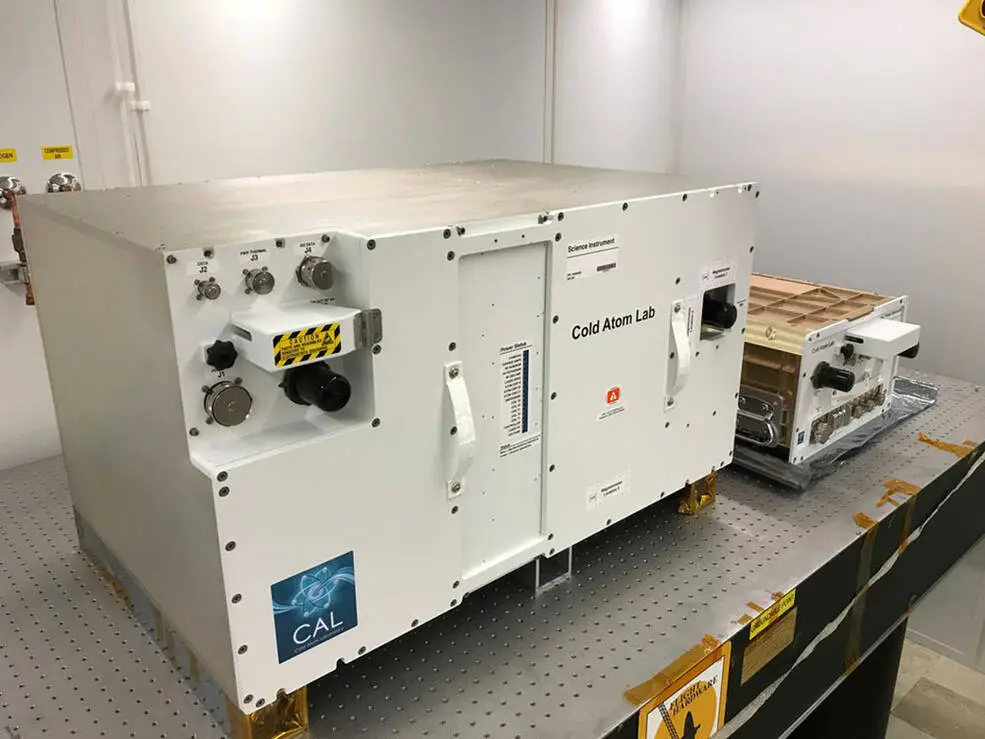
@NASA’s Cold Atom Lab, the first quantum physics facility aboard the International Space Station (ISS). Cold Atom Lab makes it easier to study the quantum behaviours of atoms. One way is by chilling atoms to small fractions of a degree above the lowest temperature matter can reach, absolute zero. This causes the atoms to move more slowly, which makes them easier to study. In addition, some atoms at this temperature can collectively form a Bose-Einstein Condensate, a state of matter wherein their quantum behaviours, which are typically microscopic, can be observed on a macroscopic scale.
On Earth, atoms studied in vacuum chambers fall quickly to the floor due to gravity. Inside Cold Atom Lab, atoms float weightlessly for longer periods, giving scientists more time to manipulate them and study how they behave and evolve. Researchers can also manipulate the ultracold atoms into bubbles and other unique shapes that are impossible to form on Earth. This reveals how different geometries affect the behaviour of quantum materials. The research, published in the journal Nature, demonstrates the unique capabilities of the Cold Atom Lab in exploring the quantum realm. https://www.nature.com/articles/s41586-023-06645-w
These ultracold atoms have the potential to be used in experiments with Bose-Einstein condensates (BECs), a fifth state of matter distinct from gases, liquids, solids, and plasmas. In a BEC, scientists can observe the quantum properties of atoms at a scale visible to the naked eye, such as wave-particle duality, where atoms and particles exhibit both solid object and wave-like behaviours. This enables sensors that are extremely sensitive to small rotations and essentially use these cold atoms in the Bose-Einstein condensate to make gyroscopes. @Infleqtion recently had a demonstrator of this concept for quantum navigation on a commercial flight. This technology could revolutionize space-based navigation, enabling spacecraft to determine their position and acceleration with unparalleled accuracy, even in the absence of external reference points like the Global Navigation Satellite System (GNSS). https://www.linkedin.com/posts/tolgaors_quantumpositioning-quantumnavigationsystems-activity-7196096809549590528-NL8P
The advancements made by the Cold Atom Lab have significant implications for quantum navigation and space-based missions. Quantum sensors developed from this research could be used to study cosmological mysteries like dark matter and dark energy. Dark matter is an invisible material that pulls matter together across the universe, while dark energy is an even more mysterious phenomenon causing the expansion of the universe to accelerate.
Picture Credit: Credits: NASA/JPL-Caltech – The Cold Atom Lab, a quantum science facility that operates on the International Space Station, is about the size of a small refrigerator.