


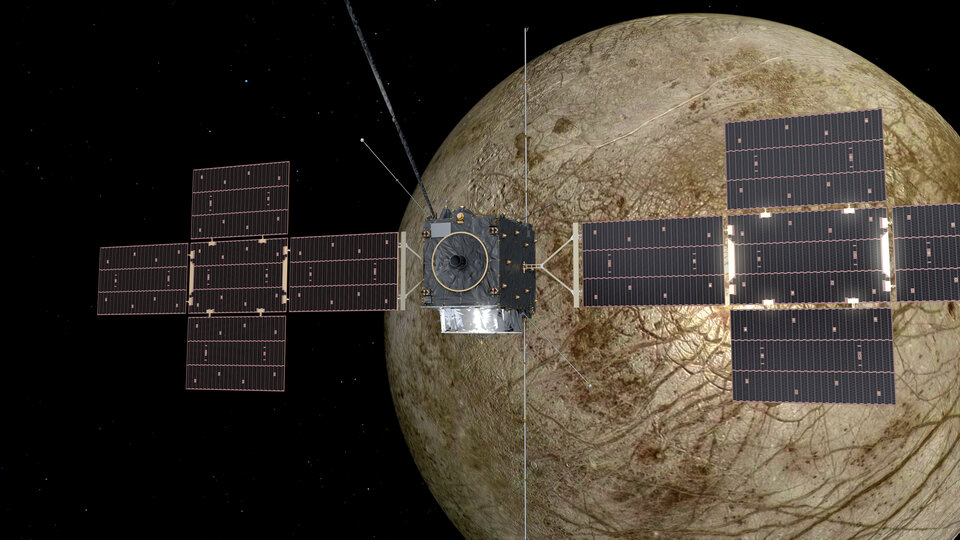
The @European Space Agency’s JUpiter ICy moons Explorer (JUICE) mission, launched on April 14, 2023, marks a significant milestone in our exploration of the outer solar system. This ambitious project aims to conduct detailed observations of Jupiter and three of its largest moons: Ganymede, Callisto, and Europa.
JUICE’s journey to Jupiter will take approximately 7.5 years, involving multiple planetary flybys for gravity assists. The spacecraft is expected to arrive at Jupiter in July 2031, where it will spend at least three years studying the Jovian system.
NASA’s Europa Clipper mission, scheduled to launch in October 2024 will be the first spacecraft designed to observe Europa exclusively and thoroughly and will arrive at Europa before JUICE. This timing will allow for potential collaborative studies between the two missions, enhancing our overall understanding of the icy moon Europa.
JUICE will investigate the potential habitability of Jupiter’s ocean-bearing moons. The mission will characterize these celestial bodies as both planetary objects and possible habitats, providing unprecedented insights into their composition, structure, and potential for supporting life. Approximately four years after its arrival at the Jupiter system, JUICE will move into orbit around the gas giant’s largest moon, Ganymede, to conduct the most extensive exploration of this moon. Equipped with a suite of advanced instruments. Scientists hope the mission will help them better understand why the Ganymede has its own magnetic field, which has not been seen in any other moon in the solar system. https://www.esa.int/Science_Exploration/Space_Science/Juice/The_science_Juice_s_key_objectives_at_Jupiter
Beyond the moons, JUICE will explore Jupiter’s complex environment in depth. This includes studying the planet’s atmosphere, magnetosphere, and the interactions between Jupiter and its satellite system. By examining the Jupiter system as a whole, scientists hope to gain a better understanding of gas giants across the universe.