


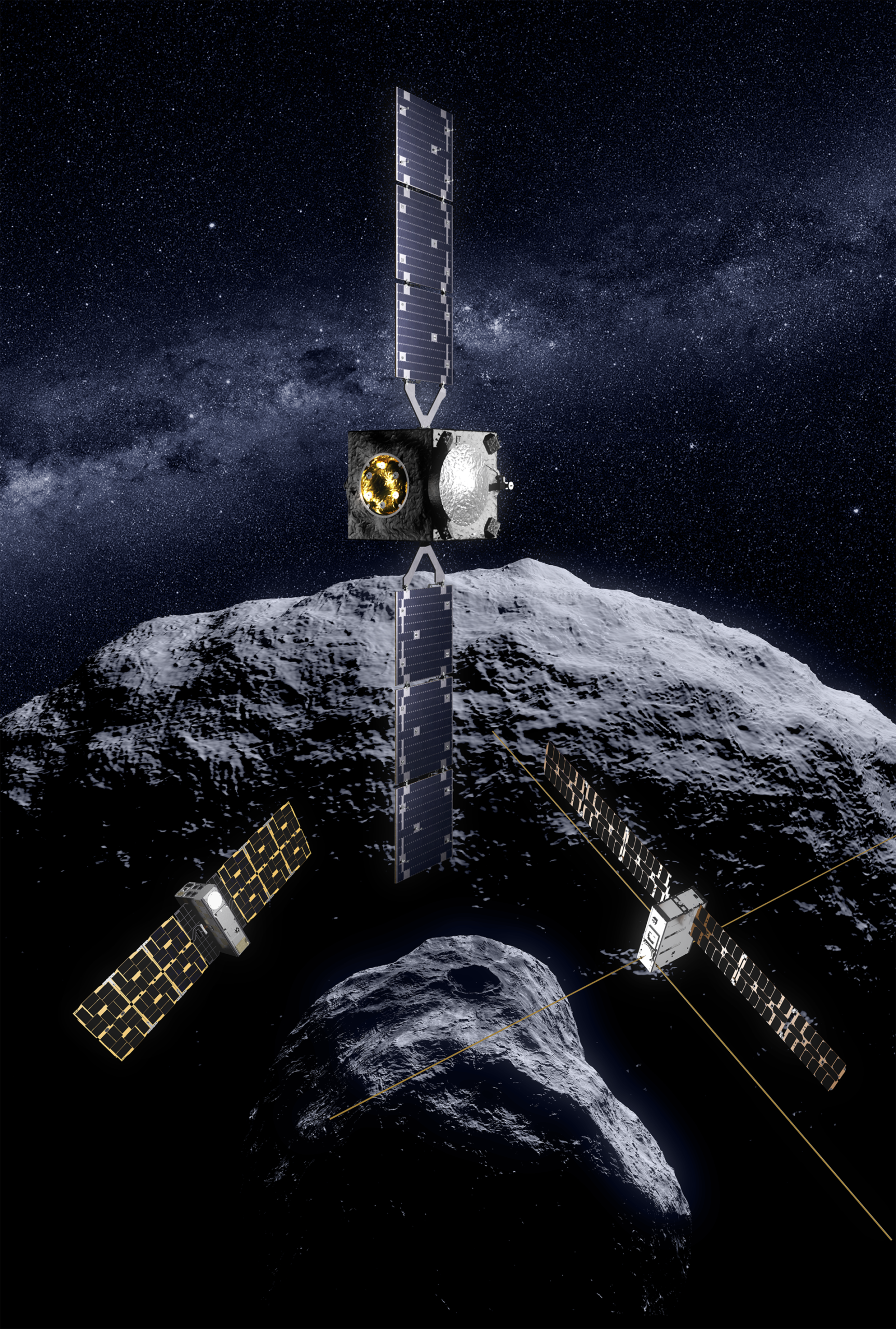
The international Asteroid Impact Deflection Assessment (AIDA) collaboration, aimed at enhancing our understanding of near-Earth objects (NEOs) and validating planetary defense techniques. The AIDA mission is a joint international collaboration between NASA, European Space Agency (ESA), German Aerospace Center (DLR), Côte d’Azur Observatory (OCA), and Johns Hopkins University Applied Physics Laboratory. AIDA consists mainly of the NASA DART and ESA Hera missions.
Asteroid Didymos and its small moonlet Dimorphos make up what’s called a binary asteroid system – meaning the small moon (Dimorphos) orbits the larger body (Didymos). Dimorphus has a radius of 85m and mass of 5 billion kg.
Following DART’s impact on Dimorphos in September 2022, Hera is scheduled for launch in October 2024. It will reach the asteroid pair in late 2026 to conduct a post-impact survey. By measuring Dimorphos’s altered orbit and mass, Hera aims to provide data on asteroid deflection techniques. This information will allow for the validation or refinement of numerical models of asteroid impact processes, rendering this deflection technique for planetary defense ready for operational use if ever needed to safeguard our home world, Earth.
Hera’s other objectives are gathering data on the asteroids’ composition and structure. The Hera mission comprises three spacecraft: the main Hera craft and two shoebox sized CubeSats: Milani will make spectral surface observations, while Juventas will undertake the first-ever radar soundings within an asteroid. These CubeSats will fly up to a few dozen kilometers from the main craft to explore the Didymos system. An inter-satellite link radio technology, developed by Portuguese company @Tekever, will facilitate communication between the spacecraft.
The AIDA collaboration, through the combined efforts of DART and Hera, exemplifies the power of international cooperation in space exploration and planetary defense. While each mission has individual value, their combined effort significantly enhances the scientific and technological returns. This international collaboration is crucial for addressing global challenges and advancing our capabilities to protect Earth from potential asteroid threats.