


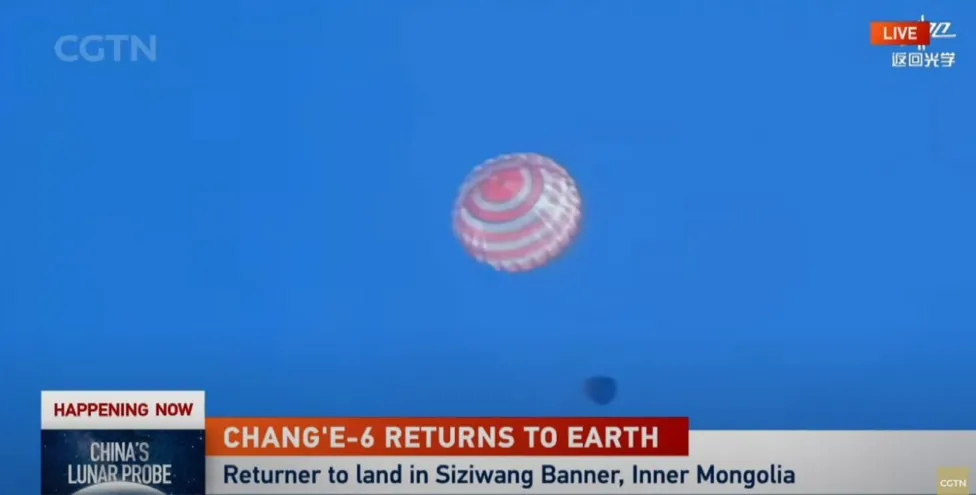
China’s Chang’e-6 mission has achieved a historic milestone in lunar exploration, successfully returning the first-ever samples from the Moon’s far side. This mission, which concluded with a landing in Inner Mongolia on Tuesday, will help our understanding of lunar geology and planetary formation.
The Chang’e-6 mission, named after the Chinese moon goddess, touched down on the 2nd of June on the side of the moon that is never seen from Earth. Only one side of the moon is visible to Earth because it is tidally locked and completes one full rotation in the time it takes to circle the planet.
The mission’s lander spent two days collecting rock and soil from one of the oldest and largest craters on the moon, the 1,600-mile-wide South Pole-Aitken (SPA) basin, using a robotic arm and drill. Its ascent module then lifted off from the moon’s surface and rendezvoused with the orbiter before embarking on its journey home. https://www.linkedin.com/posts/tolgaors_samplereturn-lunarexploration-lunarsamples-activity-7204799270611333123-gvFV
Scientists worldwide are eagerly anticipating the analysis of these samples, which could provide crucial insights into the Moon’s formation, evolution, and potential resources like ice deposits. The far side’s composition may hold keys to understanding the Moon’s mysterious asymmetry and its relationship with Earth. The current prevailing theory suggests that the Moon formed when a Mars-sized body collided with the early Earth, ejecting debris that coalesced into our lunar companion. Samples from the far side could offer new evidence to support or challenge this theory.
What makes this mission particularly exciting is the wealth of expertise ready to be applied to these samples. Specialized laboratories around the world have spent five decades finessing the analytical techniques to tease out the moon’s secrets from within near side samples returned by the Apollo and Luna missions. And now all that expertise will be applied to learn about the enigmatic far side of the moon.
This achievement not only advances scientific knowledge but also intensifies global interest in lunar exploration. China’s plans for a crewed lunar mission by 2030 and the establishment of a base on the lunar south pole further underscore the nation’s commitment to space exploration.