


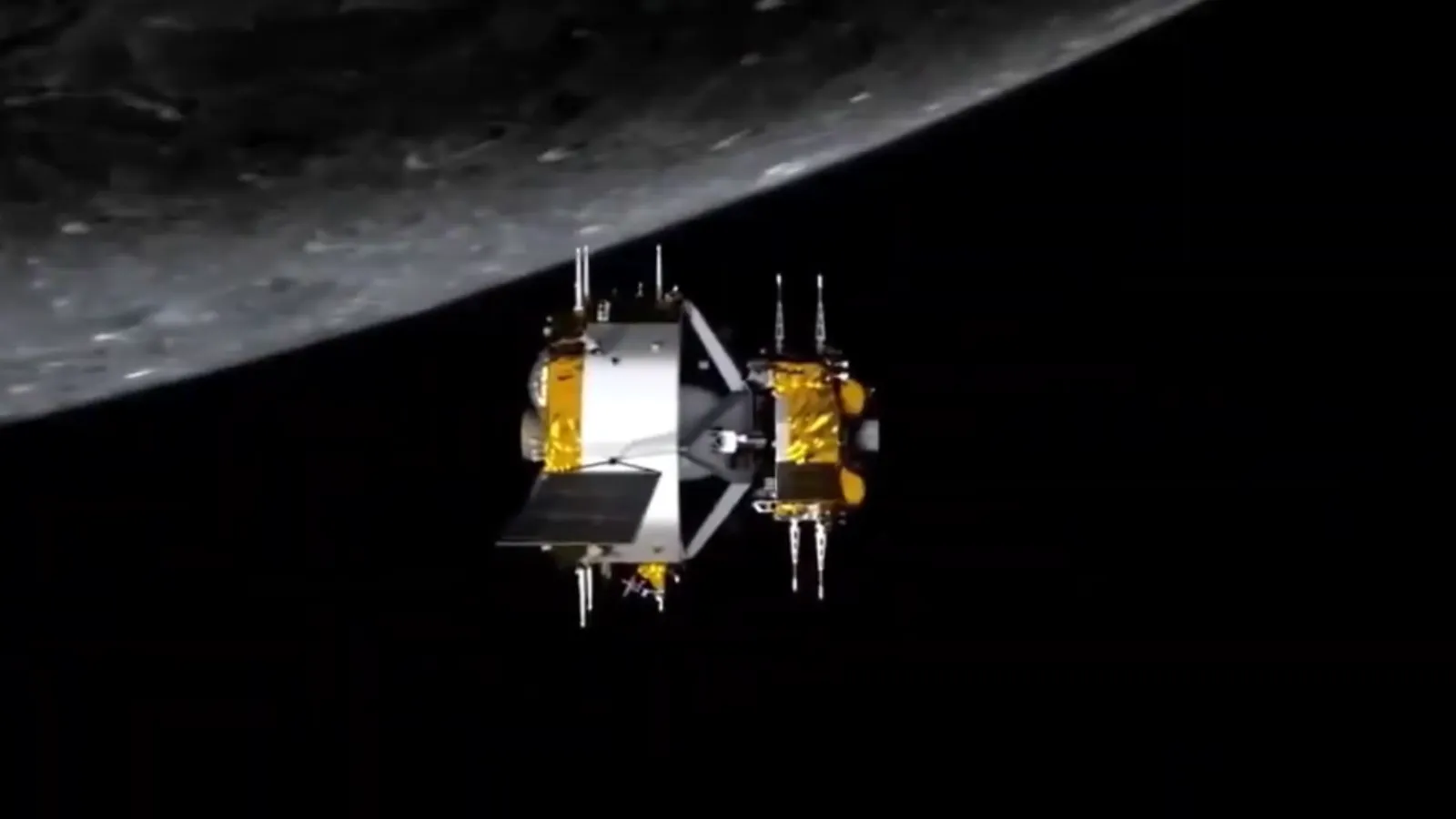
China’s Chang’e 6 mission has successfully transferred the first-ever samples collected from the far side of the moon between spacecraft in lunar orbit. This was a crucial step for the samples’ eagerly anticipated return to Earth.
The Chang’e 6 rocket, carrying the lunar samples, blasted off from the moon’s surface on June 4 and entered lunar orbit. It then approached the Chang’e 6 orbiter. The rendezvous and docking procedure utilized a “handshake” and “hold tight” method, which took approximately 21 seconds to complete, ensuring a secure connection between the two spacecraft. The China National Space Administration (CNSA) announced that the Chang’e 6 moon probe’s ascender and orbital module successfully rendezvoused and docked and that the safe transfer of the lunar sample container was completed. This marks the second time a CNSA spacecraft has achieved lunar orbit rendezvous and docking, following the success of the Chang’e 5 mission. To date, China remains the only country to have successfully achieved a soft landing on the lunar far side, with the previous feat accomplished by the Chang’e 4 robotic lander and rover.
With the samples now safely aboard the orbiter, the Chang’e 6 mission will continue its journey. The orbiter is expected to remain in lunar orbit for about 14 days, waiting for the optimal window to transfer to an orbit around Earth. Once in Earth orbit, the Chang’e 6 orbiter will dispatch the sample return canister, which is anticipated to drift back to Earth via parachute on June 25.
Scientists are eager to study these samples, hoping to unravel lingering mysteries about the moon’s far side. The analysis of this lunar material could potentially shed light on why the near side of the moon is characterized by vast ancient lava flows, known as “lunar maria,” while such features are absent from the far side’s fine, dusty composition.