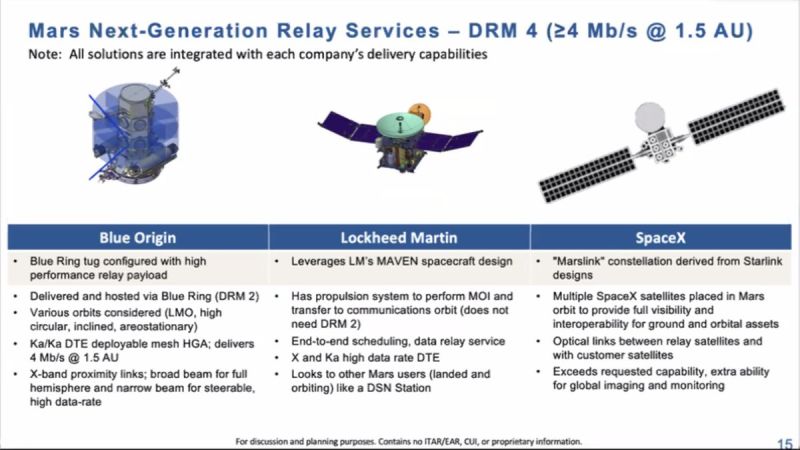
In May this year NASA selected commercial service studies to enable science missions to Mars. One of the 4 commercial categories is 𝗡𝗲𝘅𝘁-𝗚𝗲𝗻𝗲𝗿𝗮𝘁𝗶𝗼𝗻 𝗥𝗲𝗹𝗮𝘆 𝗦𝗲𝗿𝘃𝗶𝗰𝗲𝘀. Three companies were chosen to write a report on how they could adapt their existing spacecraft to provide relay services from Mars:
· SpaceX, adapt Earth-orbit communication satellites for Mars
· Lockheed Martin Space, provide communication relay services via a modified Mars orbiter
· Blue Origin, provide communication relay services via an adapted Earth- and lunar-vicinity spacecraft
Direct communication between Mars-based assets and Earth requires significant power due to the enormous distances involved. Relay satellites would allow rovers and other users on Mars to carry lighter, less power-hungry communication systems, as they would only need to transmit data to orbital relay satellites. This approach not only reduces payload mass but also enables a higher-bandwidth data transmission back to Earth.
SpaceX is exploring the adaptation of their Starlink satellite technology for Mars operations, conceptually dubbed 𝗠𝗮𝗿𝘀𝗹𝗶𝗻𝗸. This approach could bring their proven satellite communication expertise to interplanetary distances. Lockheed Martin Corporation is investigating how to modify their Mars orbiter 𝗠𝗮𝘃𝗲𝗻 spacecraft design to serve as dedicated relay stations, while Blue Origin is examining ways to adapt their 𝗕𝗹𝘂𝗲 𝗥𝗶𝗻𝗴 spacecraft platform for Mars communication services.
These relay satellites must maintain data rates of at least 4Mbps across approximately 1.5 astronomical units (AU), where 1 AU is 149,597,871 km. This capability would significantly enhance our ability to receive scientific data, imagery, and support future human missions to Mars.
Beyond communication capabilities, these next-generation satellites could serve a dual purpose by incorporating Positioning, Navigation and Timing (PNT) payloads. This addition would effectively create a Global Navigation Satellite System (GNSS) for Mars, providing crucial navigation infrastructure for future rovers and human explorers on the Martian surface.
The approach to outsource relay services to commercial companies will reduce costs, accelerate technological development, and enable a whole ecosystem of New Space companies to carry out scientific discovery.
Team Tumbleweed in one of these New Space start-ups that would benefit from relay as well as GNSS services provided on Mars. The successful development of these next-generation relay services would establish a critical infrastructure for future Mars exploration and settlement.
𝗖𝗼𝗺𝗺𝗲𝗿𝗰𝗶𝗮𝗹 𝗠𝗮𝗿𝘀 𝗥𝗲𝗹𝗮𝘆 𝗦𝗮𝘁𝗲𝗹𝗹𝗶𝘁𝗲𝘀: 𝗘𝗻𝗮𝗯𝗹𝗶𝗻𝗴 𝗟𝗶𝗴𝗵𝘁𝗲𝗿 𝗣𝗮𝘆𝗹𝗼𝗮𝗱𝘀 𝗮𝗻𝗱 𝗙𝗮𝘀𝘁𝗲𝗿 𝗗𝗮𝘁𝗮 𝗳𝗿𝗼𝗺 𝘁𝗵𝗲 𝗥𝗲𝗱 𝗣𝗹𝗮𝗻𝗲𝘁