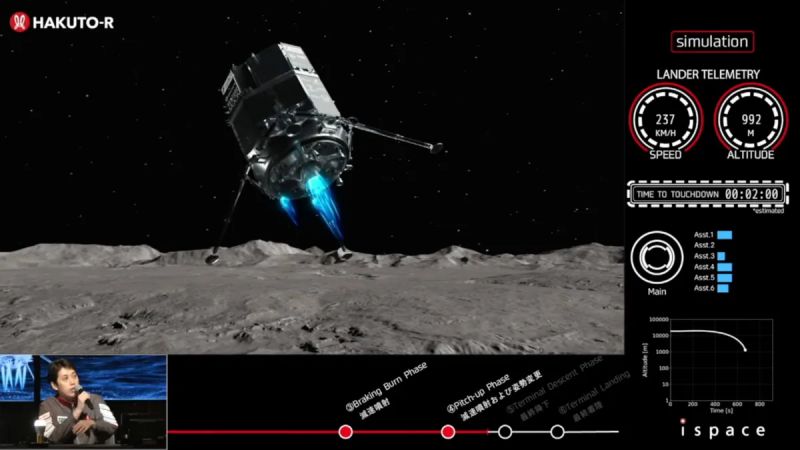
On June 6, Japan Standard Time, ispace, inc.‘s Resilience spacecraft approached the Mare Frigoris region of the moon’s near side, carrying hopes of achieving Japan’s first private soft lunar touchdown. The mission represented iSpace’s second attempt under their Hakuto-R program, building on lessons learned from their previous endeavor. However, when telemetry ceased just one minute and 45 seconds before the scheduled landing, the space community witnessed another reminder of the challenges inherent in lunar landings.
𝐓𝐡𝐞 𝐂𝐫𝐢𝐭𝐢𝐜𝐚𝐥 𝐌𝐨𝐦𝐞𝐧𝐭𝐬
Preliminary analysis of Resilience’s final telemetry data reveals a concerning pattern that extends beyond this single mission. The spacecraft’s laser rangefinder experienced issues while measuring distance to the lunar surface, leaving the 2.3-meter-tall, 1,000-kilogram lander traveling at 187 km/h at an altitude of just 52 meters. This residual velocity, with delayed altitude readings, proved too high for the controlled deceleration required for a soft landing, resulting in what mission controllers confirmed as a hard landing.
𝐀 𝐓𝐫𝐨𝐮𝐛𝐥𝐢𝐧𝐠 𝐏𝐚𝐭𝐭𝐞𝐫𝐧 𝐄𝐦𝐞𝐫𝐠𝐞𝐬
The issues with Resilience’s laser altimeter system echoes a similar challenge faced by Intuitive Machines‘ Athena lander. Signal noise and distortion from Athena’s altimeters during final descent prevented accurate altitude readings, also culminating in a hard landing.
This pattern raises important questions about the reliability of current laser altimeter technology in lunar conditions. An investigation whether both missions utilized equipment from the same manufacturer could provide valuable insights for the broader space community.
𝐋𝐨𝐨𝐤𝐢𝐧𝐠 𝐅𝐨𝐫𝐰𝐚𝐫𝐝
Despite this setback, ispace maintains its commitment to lunar exploration with two missions planned for 2027. Mission 3 and Mission 4 will deploy the more capable Apex 1.0 lander, weighing 2 tons and representing a significant technological advancement over Resilience.
ispace CFO JUMPEI NOZAKI‘s acknowledgment of disappointment to the company’s 80,000 supporters and shareholders reflects the human element behind these technological endeavours. The commitment to learning from this experience for future missions demonstrates the resilience that defines the New Space industry, where each challenge becomes a stepping stone toward eventual success in humanity’s return to the Moon.
𝐢𝐬𝐩𝐚𝐜𝐞’𝐬 𝐒𝐞𝐜𝐨𝐧𝐝 𝐋𝐮𝐧𝐚𝐫 𝐌𝐢𝐬𝐬𝐢𝐨𝐧 𝐄𝐧𝐝𝐬 𝐢𝐧 𝐇𝐚𝐫𝐝 𝐋𝐚𝐧𝐝𝐢𝐧𝐠 𝐃𝐮𝐞 𝐭𝐨 𝐋𝐚𝐬𝐞𝐫 𝐀𝐥𝐭𝐢𝐦𝐞𝐭𝐞𝐫 𝐈𝐬𝐬𝐮𝐞𝐬