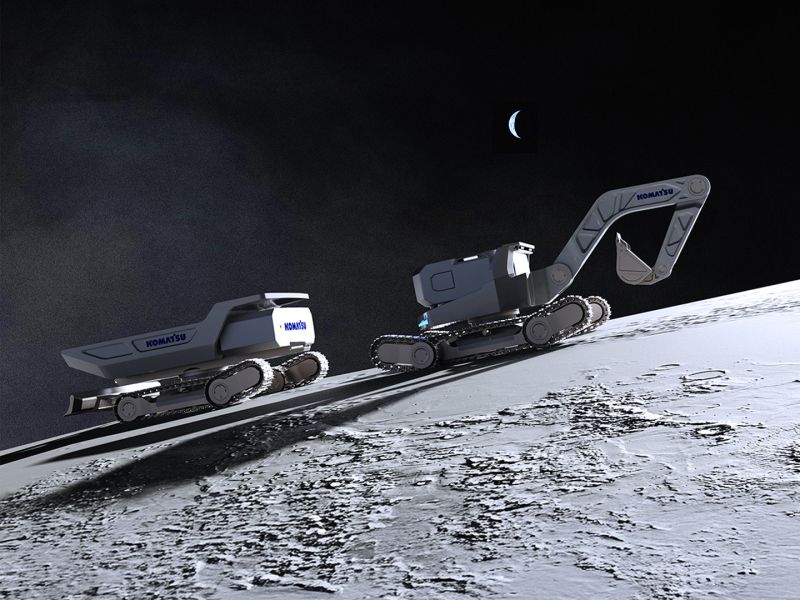
Komatsu, Japan’s established heavy equipment manufacturer, is bringing decades of terrestrial construction expertise to lunar construction. This transition represents a classic “Spin-In” scenario where proven Earth technologies are being modified for space environments.
As part of Japan’s Stardust Program, Komatsu leads the Space Construction Innovation Project with responsibility for research and development of lunar construction machines. The project aims to develop autonomous construction technologies for building a base supporting long-term lunar surface habitation by the early 2030s. The lunar environment presents three fundamental challenges that Komatsu addresses through innovative engineering approaches.
𝐋𝐨𝐰-𝐆𝐫𝐚𝐯𝐢𝐭𝐲 𝐎𝐩𝐞𝐫𝐚𝐭𝐢𝐨𝐧
First, the moon’s one-sixth gravity requires rethinking machine stability and excavation force. Through simulations, Komatsu has demonstrated that increasing the contact surface between machines and lunar regolith improves stability and excavation effectiveness without additional mass penalties.
𝐄𝐱𝐭𝐫𝐞𝐦𝐞 𝐄𝐧𝐯𝐢𝐫𝐨𝐧𝐦𝐞𝐧𝐭
Second, the extreme temperature variations on the lunar surface—from 110°C to -170°C—and lack of atmosphere necessitate alternatives to combustion engines. Komatsu is developing specialized thermal control systems and electrification technologies suitable for these conditions.
𝐂𝐫𝐚𝐭𝐞𝐫𝐬, 𝐒𝐥𝐨𝐩𝐞𝐬 𝐚𝐧𝐝 𝐑𝐞𝐠𝐨𝐥𝐢𝐭𝐡
Finally, the rugged lunar terrain, characterized by impact craters, steep slopes of 20-30 degrees, and loose regolith, demands novel mobility solutions. Komatsu’s research into multi-crawler systems shows promise for navigating these challenging surfaces while maintaining operational stability.
The company’s methodical approach leverages simulations to identify potential technical issues before physical testing. This process combines Komatsu’s traditional engineering strengths with cutting-edge modeling technology, allowing for rapid iteration and verification of solutions. Once prototypes are constructed and analog demonstrations started, digital twins will enable further optimization.
Through this lunar construction initiative, Komatsu is positioning itself within the emerging New Space economy while developing technologies that already find applications in extreme environments on Earth. The company’s progress demonstrates how established industrial firms can contribute essential capabilities to expand sustainable human presence beyond Earth.
𝐒𝐢𝐦𝐮𝐥𝐚𝐭𝐢𝐨𝐧 𝐚𝐧𝐝 𝐃𝐢𝐠𝐢𝐭𝐚𝐥 𝐓𝐰𝐢𝐧𝐬: 𝐊𝐨𝐦𝐚𝐭𝐬𝐮’𝐬 𝐀𝐩𝐩𝐫𝐨𝐚𝐜𝐡 𝐭𝐨 𝐃𝐞𝐬𝐢𝐠𝐧𝐢𝐧𝐠 𝐟𝐨𝐫 𝐋𝐮𝐧𝐚𝐫 𝐂𝐨𝐧𝐬𝐭𝐫𝐮𝐜𝐭𝐢𝐨𝐧 𝐂𝐡𝐚𝐥𝐥𝐞𝐧𝐠𝐞𝐬