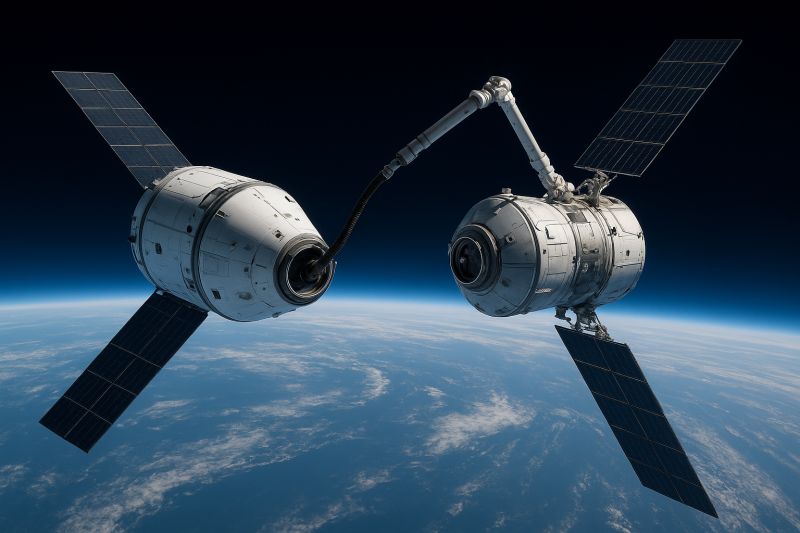
There is a growing demand for cost-effective in-space servicing, assembly, and manufacturing (ISAM). While most space companies design robots for single, specialized use cases —which limits revenue— Orbital Robotics is charting a different course. Its approach centers on generalized robotic hardware combined with AI-powered software that can be rapidly adapted for diverse missions. This model dramatically reduces development time, allowing small teams to program new robotic missions in days instead of months, and leverages the falling cost of launches to expand market viability.
Founded by Aaron Borger (CEO) and Doug Kohl (COO), the company brings together top engineering talent from across the space sector to address a critical gap in on-orbit robotics operations: lower-cost, scalable, intelligent robotics for orbital missions.
The company’s orbital operations toolkit includes:
● 𝐀𝐮𝐭𝐨𝐧𝐨𝐦𝐨𝐮𝐬 𝐒𝐭𝐚𝐛𝐥𝐞 𝐓𝐫𝐚𝐣𝐞𝐜𝐭𝐨𝐫𝐲 𝐑𝐞𝐢𝐧𝐟𝐨𝐫𝐜𝐞𝐦𝐞𝐧𝐭 𝐀𝐥𝐠𝐨𝐫𝐢𝐭𝐡𝐦 𝐰𝐢𝐭𝐡 𝐏𝐫𝐞𝐝𝐢𝐜𝐭𝐢𝐨𝐧 (𝐀𝐒𝐓𝐑𝐀-𝐏): An autonomous guidance and control framework to enable robust trajectory planning for rendezvous, proximity operations, docking, robotic manipulation, and terrain relative guidance (lunar and asteroids).
● 𝐍𝐚𝐯𝐈𝐐: Intelligent vision-based perception software for resident space object and lunar/asteroid terrain relative navigation.
● 𝐑𝐨𝐛𝐨𝐭𝐢𝐜 𝐌𝐚𝐧𝐢𝐩𝐮𝐥𝐚𝐭𝐨𝐫 (𝐀𝐬𝐭𝐫𝐨𝐛𝐨𝐭): In-orbit test planned for late 2026.
Orbital Robotics’ services include spacecraft refuelling, satellite repair and upgrade, inspection and surveillance, orbital station assembly and servicing operations, as well as space debris mitigation—all powered by their 𝐅𝐫𝐞𝐞-𝐅𝐥𝐲𝐞𝐫 𝐬𝐩𝐚𝐜𝐞𝐜𝐫𝐚𝐟𝐭 platform.
Collaborations further reinforce their momentum. The company has signed a Letter of Intent with Space Ocean Corp. to integrate autonomous robotic arm systems into future spacecraft and partnered with Matrix MDT for rapid prototyping of space-grade robotic arms—both companies sharing roots in Blue Origin leadership.
As an advisor to Orbital Robotics, I’ve observed how their scalable multi-mission approach positions them uniquely in the emerging in-orbit services market. By combining adaptable hardware with AI-driven software, they’re not just building robots for today’s missions—they’re creating a platform that can evolve alongside the space industry’s needs.
𝐎𝐫𝐛𝐢𝐭𝐚𝐥 𝐑𝐨𝐛𝐨𝐭𝐢𝐜𝐬: 𝐆𝐞𝐧𝐞𝐫𝐚𝐥𝐢𝐳𝐞𝐝 𝐒𝐩𝐚𝐜𝐞 𝐑𝐨𝐛𝐨𝐭𝐢𝐜𝐬 𝐀𝐝𝐚𝐩𝐭𝐚𝐛𝐥𝐞 𝐭𝐨 𝐌𝐮𝐥𝐭𝐢𝐩𝐥𝐞 𝐌𝐢𝐬𝐬𝐢𝐨𝐧 𝐏𝐫𝐨𝐟𝐢𝐥𝐞𝐬